Industrial Mixers UK
PerMix News & Updates

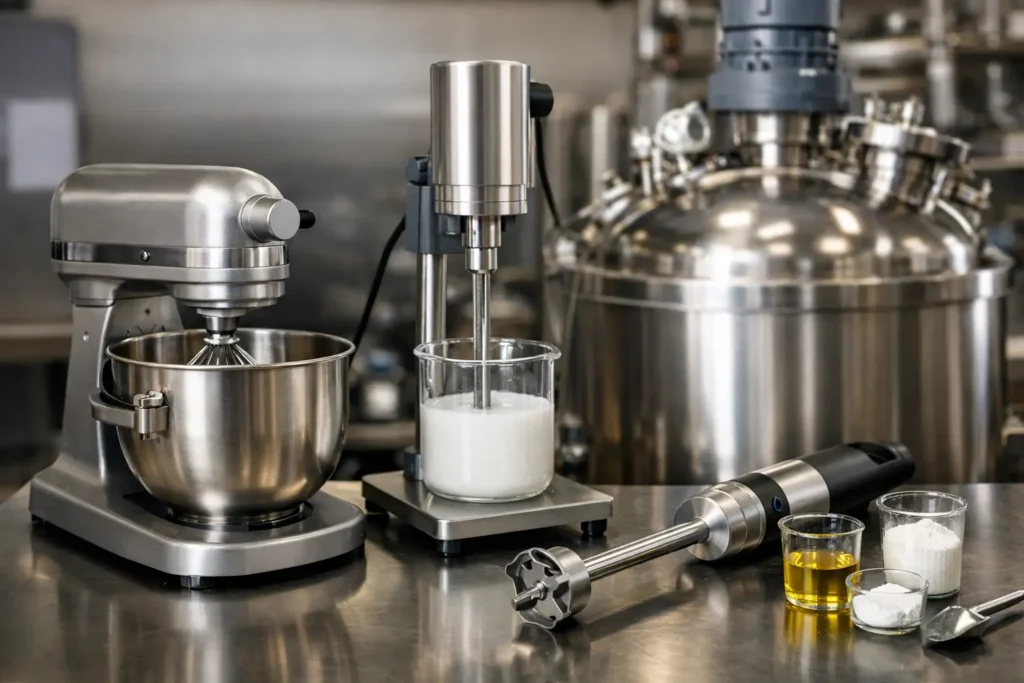
A batch that blends perfectly in a pilot trial can fail at production scale for one simple reason – the mixing equipment does not match the material behaviour. That is why the question what equipment is used for mixing matters so much in industrial manufacturing. In practice, the answer depends on whether you are handling free-flowing powders, viscous pastes, low-viscosity liquids, fragile solids, shear-sensitive formulations, or products that also need heating, cooling, vacuum, or hygienic processing.
For process engineers and technical buyers, mixing is not one equipment category but a broad family of machines designed around product rheology, batch size, process objective, and plant constraints. The right choice affects blend uniformity, throughput, cleaning time, energy use, operator safety, and downstream performance. The wrong one tends to show up later as segregation, hot spots, agglomerates, air entrapment, inconsistent viscosity, or poor repeatability between batches.
Industrial mixing equipment can be grouped broadly into powder mixers, liquid mixers, paste and high-viscosity mixers, and integrated process vessels that combine mixing with thermal or pressure control. Within those groups, the actual machine type is selected according to how the material needs to move.
A free-flowing powder blend may require a gentle convective mixer that achieves uniformity without damaging particle shape. A liquid-liquid system may need turbulent agitation for rapid turnover. A high-viscosity adhesive may need planetary movement and wall-scraping action to force material from stagnant zones back into the mix. In other words, specifying a mixer is less about naming a machine and more about matching a mixing mechanism to a process requirement.
For dry powders, granules, and particulate blends, common equipment includes ribbon blenders, paddle mixers, ploughshare mixers, conical screw mixers, and V blenders. Each works differently, and that difference matters.
Ribbon blenders are widely used for relatively free-flowing powders and dry blends where good homogeneity is required within a practical batch cycle. The inner and outer ribbons move material in opposite axial directions, producing efficient bulk circulation. They are often chosen in food, nutraceutical, and chemical applications where there is a need for consistent blending with optional liquid addition.
Paddle mixers are useful where a gentler action is preferred or where materials vary in bulk density and particle size. Their controlled mixing pattern can help reduce degradation and can be effective for powders, granules, and some wet massing duties.
Ploughshare mixers are designed for more intensive mechanical action. Their high-speed mixing zone can break up lumps and improve dispersion, especially where powders need liquid addition or where a more aggressive process is required. They are often considered when short cycle times are important, but that higher intensity is not ideal for every formulation.
Conical screw mixers suit applications with delicate powders, wide fill levels, or heat-sensitive materials. Their vertical geometry is useful where floor space is limited and where gentle, thorough mixing is needed with low energy input. They are also attractive when batch integrity and discharge performance are priorities.
V blenders are typically used for dry powders that mix readily and do not need high shear. They offer a simple tumble-blending action, though they are generally less suitable where dispersion, deagglomeration, or liquid incorporation is required.
When the product is primarily liquid, the equipment selection shifts towards agitators, high shear mixers, inline mixers, and mixing vessels fitted with specific impeller designs. The fluid viscosity, the need for emulsification, and the desired mixing speed drive the choice.
For straightforward blending, dissolving, or suspension duties, an agitator in a tank may be enough. Propellers, turbines, and pitched-blade impellers are selected according to whether the process needs axial flow, radial flow, surface turnover, or solids suspension. Even at this level, tank geometry, baffle design, and shaft speed are central to performance.
High shear mixers are used where the process involves emulsification, dispersion, particle size reduction, or rapid incorporation of powders into liquids. These machines generate intense localised shear, which is useful in cosmetics, pharmaceuticals, chemicals, and food processing. They can operate as batch units within vessels or as inline systems integrated into a continuous process.
Inline mixers are often chosen when recirculation, controlled process residence time, or direct integration with filling and transfer lines is needed. They can improve consistency and reduce batch handling, but they rely on the wider system being designed correctly.
As viscosity rises, standard agitators become less effective. Materials such as pastes, creams, sealants, adhesives, compounds, and filled formulations need equipment that can physically move heavy product through the vessel and continually expose it to the mixing element.
Planetary mixers are a common choice for medium to high-viscosity products. Their mixing tools rotate on their own axes while orbiting the vessel, which improves coverage and reduces dead zones. For formulations that cling to the vessel wall, scraper blades can be added to maintain heat transfer and keep the batch moving.
Double planetary mixers are suited to very viscous products where torque, thorough folding action, and controlled processing are required. They are frequently used for sealants, putties, composites, battery materials, and similar demanding products.
Sigma mixers, also known as kneaders, are used for dough-like, plastic, or highly viscous masses. Their blades work material with a powerful kneading action, making them appropriate for products that cannot be mixed effectively with conventional agitation.
For very high-performance applications, vacuum-capable planetary or dispersing systems may be specified to remove entrained air while mixing. That matters when product appearance, density, filling accuracy, or downstream curing is affected by trapped gas.
In many production environments, mixing is only one part of the duty. The product may also need heating, cooling, pressure control, vacuum deaeration, fermentation, reaction control, or hygienic containment. In those cases, the equipment is better understood as a process vessel with an engineered mixing system rather than just a mixer.
Jacketed tanks and kettles are used where temperature control is part of the batch cycle. Reactors and pressure vessels may be required for chemical processing, controlled reactions, or hazardous materials. Hygienic vessels are designed for cleanability, product integrity, and compliance in sectors such as food, dairy, and pharmaceuticals. The mixing head, vessel finish, seal arrangement, and instrumentation all become part of the specification.
This is where standard equipment often reaches its limit. A mixer that performs well mechanically may still be the wrong choice if the process also requires CIP design, ATEX compliance, vacuum service, or validated surface finishes.
Anyone asking what equipment is used for mixing is usually really asking a more practical question: what equipment is right for this product, in this factory, at this throughput, under these compliance conditions? That answer starts with the material itself.
The first consideration is product state and viscosity. Powders, slurries, liquids, and pastes behave differently, and some products change character during the batch. A formulation may begin as a free-flowing liquid and end as a high-viscosity paste after powder addition or reaction. Equipment must suit the full process, not just the starting point.
The second is the mixing objective. Blending, dispersion, emulsification, homogenisation, wet granulation, heating, cooling, and deaeration are not interchangeable duties. A blender designed for dry homogenisation will not necessarily disperse fine powders into a liquid phase. A high shear mixer may solve one problem while damaging fragile particulates or generating too much heat.
The third is batch size and production regime. Pilot-scale assumptions often fail when scaled up without attention to tip speed, shear profile, residence time, and heat transfer. Continuous production brings another set of decisions around flow control, cleaning strategy, and integration with upstream and downstream equipment.
Then there are plant and regulatory factors. Available headroom, discharge height, utility supply, zoning requirements, hygienic standards, and maintenance access all influence the equipment configuration. In regulated sectors, documentation and compliance are as important as mechanical performance.
Off-the-shelf mixers are suitable for many duties, but industrial processes are rarely as simple as a catalogue line. Small changes in powder density, viscosity curve, solvent content, abrasiveness, or temperature sensitivity can change the equipment requirement significantly.
That is why many manufacturers specify bespoke features such as intensifier choppers, load cells, vacuum systems, heating jackets, scraper agitation, seal flushing, automated controls, or special discharge valves. The core mixer type may remain standard, but the final system is engineered around the process.
For industrial buyers, this is usually where value is created. A lower-cost machine that struggles with cleaning, cycle time, or repeatability quickly becomes expensive in operation. By contrast, a properly specified system supports output, quality, and compliance over the long term.
PerMix UK operates in that space between standard mixer categories and application-specific engineering, which is often where the best specification decisions are made.
If you are assessing mixing equipment, the most useful starting point is not the machine name but the process problem. Once the material behaviour, production target, and operating conditions are clearly defined, the right equipment choice tends to become much clearer.
Stay Connected