Industrial Mixers UK
PerMix News & Updates

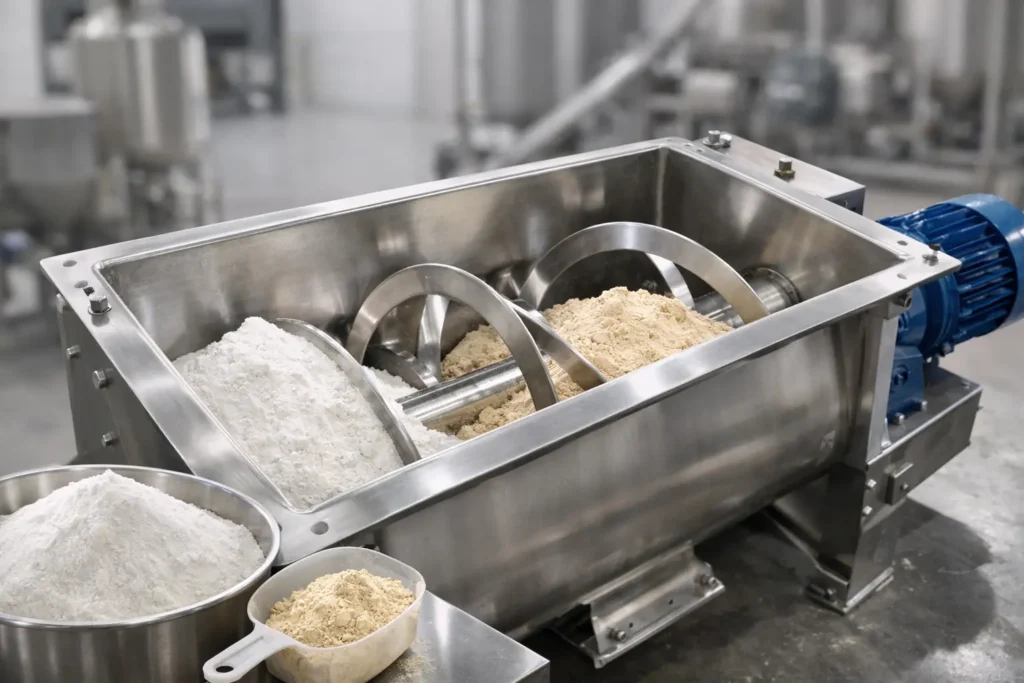
A ribbon blender for powders is often specified when a process needs dependable batch blending at practical throughput, without unnecessary mechanical complexity. In production, that usually means one thing – achieving a consistent mix across dry ingredients while keeping cleaning, discharge and cycle time within acceptable limits. For manufacturers handling food ingredients, chemical blends, nutraceutical premixes or technical powders, the machine itself is only part of the decision. The application defines whether a ribbon blender is the right fit.
Ribbon blenders remain widely used because they suit a broad range of free-flowing to moderately cohesive powders. The horizontal trough and double helical ribbon arrangement create a controlled convective mixing pattern, moving material both axially and radially. In practice, that allows efficient blending of bulk solids where the objective is homogeneity rather than aggressive size reduction or high-shear dispersion.
This matters in sectors where a formulation must be blended evenly but treated gently. Food and beverage manufacturers may be combining seasoning bases, dry bakery ingredients or beverage powders. In chemicals, the duty may involve mineral blends, additives or powdered compounds. In nutraceutical and pharmaceutical support applications, the requirement may be accurate premixing before downstream processing. Across these cases, the attraction is straightforward – good batch uniformity, relatively simple mechanics and scalable capacity.
That said, suitability depends on powder behaviour. A ribbon blender is typically strongest where materials flow reasonably well and where the recipe does not demand intensive deagglomeration. If a product is highly cohesive, fragile, heat-sensitive or prone to smearing, another mixer technology may offer a better result. Selecting on familiarity alone is where specification problems begin.
The core mixing action comes from inner and outer ribbons rotating within a U-shaped horizontal vessel. One ribbon pushes material in one axial direction while the other moves it in the opposite direction. At the same time, material circulates from the vessel wall towards the centre and back again. This repeated movement produces the bulk exchange needed for a uniform blend.
For many dry formulations, that mechanism is effective because it avoids dead zones when the machine is properly designed and correctly filled. Batch loading level has a direct effect on performance. Too little fill reduces contact between the powder bed and the ribbon geometry. Too much fill can restrict movement and extend blend times. This is why working volume, not just total vessel volume, should be reviewed carefully during equipment selection.
Drive speed also deserves attention. Faster is not always better. Excessive tip speed can create product degradation, dusting or unnecessary wear, while insufficient speed may extend cycle times beyond what production can tolerate. The right balance depends on bulk density, particle size distribution, sensitivity of ingredients and the required blend quality.
A ribbon blender is rarely bought on mixing principle alone. Industrial buyers need to assess how the machine will perform within the full process, including charging, blending, discharge, cleaning and integration with upstream and downstream equipment.
Capacity should be considered in terms of useful batch volume and achievable throughput per shift, not just nominal litres. A 1,000-litre vessel may look suitable on paper, but if the formulation requires longer blending times, manual charging steps or extended cleaning between recipes, actual output may fall short of target. For operations planning, those practical constraints matter as much as the vessel size.
Material characteristics are equally important. Bulk density, angle of repose, moisture sensitivity and particle fragility all influence the final specification. A lightweight powder blend behaves very differently from a dense mineral formulation. Where micro-ingredients are added in small percentages, the blender must provide enough repeatable movement to distribute them evenly without segregation after discharge.
Discharge arrangement is another area where performance can vary significantly. A poorly designed outlet can leave residual material in the trough, reduce yield and complicate changeovers. Butterfly valves, slide valves and bomb-bay style discharges may each be suitable depending on the application, but the right choice depends on product flow, hygiene requirements and downstream transfer method.
In industrial environments, the useful life of a mixer depends on more than the ribbon assembly. Construction quality, weld finish, shaft sealing and drive selection all affect reliability and compliance.
For hygienic sectors, internal surface finish and cleanability are central considerations. If the blender is handling food, nutraceutical or cosmetic powders, crevice-free internal design, polished contact surfaces and suitable seals help reduce retention and simplify washdown or dry cleaning. Inspection covers, access ports and removable components can also improve maintenance and validation procedures.
For hazardous or solvent-related environments, the design may need to address ATEX requirements, earthing, dust management and suitable electrical specification. In chemical processing, this is not a secondary detail. It is part of making the equipment fit for site conditions and safe in operation.
Wear resistance can also become critical with abrasive formulations. Standard construction may be adequate for many products, but harder materials can accelerate wear on ribbons, trough surfaces and discharge areas. In those cases, upgraded materials of construction or wear-resistant treatments may be justified on lifecycle cost grounds.
Automation level should match the plant strategy. Some sites need a stand-alone batch blender with straightforward local controls. Others require recipe management, load cell integration, automated ingredient charging, interlocked discharge and communication with a wider line control system. There is little value in over-specifying controls, but under-specifying them can create avoidable labour and traceability issues.
A ribbon blender is versatile, but it is not universal. If the process requires very fast dispersion of minor ingredients into a difficult base powder, high-intensity mixing tools may be more suitable. If the product forms stable agglomerates, a lump breaker or alternative mixer design may be needed. If fragile particles must remain intact, even a well-configured ribbon blender may create more attrition than desired.
Thermal sensitivity is another factor. Although ribbon blenders are not generally high-shear machines, prolonged blend times can still contribute to temperature rise in some products, especially at scale. Where heating or cooling control is required, a jacketed configuration may be appropriate, but that should be assessed against actual process need rather than assumed as a standard feature.
There is also the issue of segregation after blending. A ribbon blender may achieve an excellent blend inside the vessel, but if the formulation contains wide differences in particle size or density, segregation can still occur during discharge, conveying or filling. In those situations, the mixer cannot be evaluated in isolation. The full handling route must be considered.
For many manufacturers, the best ribbon blender for powders is not an off-the-shelf machine with standard dimensions and controls. It is a machine configured around the product, the site and the production method.
That may include customised inlet arrangements for sack tipping, screw feeding or vacuum conveying. It may mean jacketed troughs for temperature conditioning, intensifier bars for difficult additives, or special shaft seals for containment and hygiene. It may also involve platform design, integrated safety guarding, load cells or downstream packaging interfaces.
This is where engineering support becomes commercially valuable. A supplier that understands process constraints can help avoid common mismatches – undersized drives, poor discharge geometry, inadequate access for cleaning or specifications that satisfy a quotation sheet but not the production floor. For UK and European manufacturers working under strict compliance, hygiene and throughput expectations, those details are not extras. They are part of the core machine requirement.
The strongest equipment decisions are made by starting with the product and the production target, then matching the mixer technology to that reality. A ribbon blender remains a proven and efficient option for many powder applications, particularly where batch consistency, practical throughput and mechanical simplicity are priorities. But the right specification depends on more than vessel size and motor power.
For buyers comparing options, the useful questions are specific. How does the powder behave at working volume? What blend uniformity is required and how is it measured? How much residue is acceptable at discharge? What cleaning regime is needed between recipes? How will the machine integrate with the rest of the line? A supplier such as PerMix UK should be able to answer those points in engineering terms, not just catalogue language.
A well-specified blender earns its place by making production more predictable. If the machine suits the formulation, the cleaning regime and the site conditions, it does not simply mix powders – it supports output, consistency and control batch after batch.
Stay Connected