Industrial Mixers UK
PerMix News & Updates

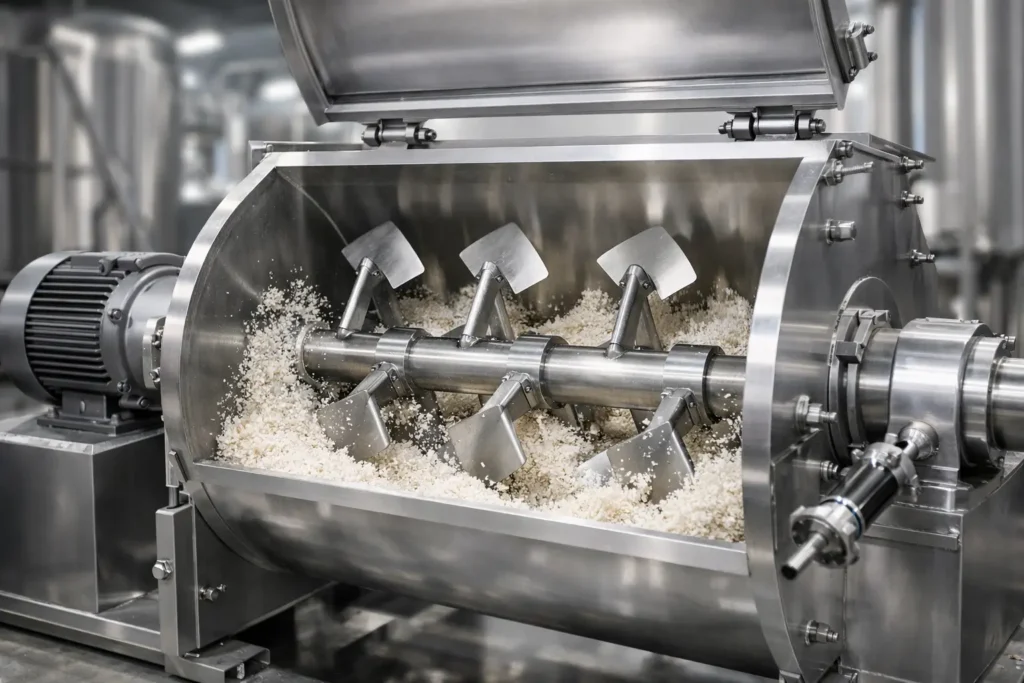
Granule blending becomes difficult when the specification sounds simple but the product does not behave that way. Free-flowing material may segregate during charging, fragile particles may break under excessive shear, and trace additives can be hard to distribute evenly. In these situations, a ploughshare mixer for granules is often considered because it combines rapid mechanical fluidisation with controlled, high-intensity mixing.
That does not make it the automatic answer for every granular process. The right decision depends on particle size distribution, bulk density, fragility, batch size, cleaning regime, and whether the process needs more than blending alone. For manufacturers assessing equipment for food, chemicals, pharmaceuticals, nutraceuticals, or advanced materials, the value lies in understanding what this mixer does well and where another design may be a better fit.
A ploughshare mixer uses a horizontal cylindrical vessel with a central shaft fitted with specially shaped mixing elements. As the shaft rotates, these plough-shaped tools lift and throw material into a mechanically generated fluid bed. Rather than relying on slow tumbling, the mixer creates a dynamic mixing zone across the full batch.
For granules, that action can be highly effective because it promotes rapid movement in multiple directions. Material is dispersed radially and axially, helping to reduce dead zones and shorten mixing times. When the process includes minor ingredients, pigments, additives, or small quantities of liquids, the vigorous but controllable movement can also improve distribution compared with lower-energy mixer types.
The practical result is a mixer that sits between gentle tumbling and very aggressive high-shear systems. It offers strong convective mixing, with optional choppers or intensifiers available when deagglomeration or liquid incorporation is required.
Granules are often easier to move than cohesive powders, but they bring their own process risks. Segregation is a common issue, especially where there are differences in particle size or density. A conventional ribbon mixer may achieve a visually acceptable blend yet still struggle to maintain uniformity if the material separates quickly.
A ploughshare mixer for granules addresses this by keeping particles in active suspension during the blend cycle. Because the bed is continuously re-formed, the contact pattern between particles is more intensive than in slower-moving systems. This can be particularly useful where formulation accuracy matters, such as functional food blends, detergent granules, fertiliser products, or speciality chemical compounds.
There is also a throughput advantage in many installations. Faster blend times can improve batch turnover, and short cycle times are often valuable where upstream and downstream equipment already operate at a high rate. That said, speed must be balanced against particle integrity. Some granules tolerate energetic movement well, while friable products may require lower shaft speeds, altered plough geometry, or an alternative mixer design altogether.
The best applications are usually dry or near-dry granular blends that need fast, homogeneous mixing without extended residence time. This includes base granules with low-dose additives, products requiring colour or flavour distribution, and processes where a small amount of liquid is sprayed in for coating or conditioning.
In regulated sectors, the design can also be advantageous when hygienic construction, repeatable batch performance, and documented process control are priorities. Stainless steel contact parts, polished finishes, CIP capability, sealed covers, dust-tight charging, and automated discharge arrangements can all be specified to suit the production environment.
Where the process is more complex, the mixer may form part of a wider system rather than operating as a standalone machine. Load cells, spray manifolds, vacuum conveying interfaces, temperature control, and explosion protection measures can be integrated depending on the material and site requirements.
Selecting a mixer on nominal capacity alone is rarely enough. Granular products behave differently from one formulation to the next, even where particle size appears similar on paper.
If the granules are brittle, abrasive, or value-critical, attrition must be assessed early. A high-energy mixing action can shorten blend times, but excessive impact may generate fines, alter downstream flow, or affect product appearance. Test work should look not only at blend uniformity, but also at post-mix particle size profile.
Ploughshare mixers typically perform best within a defined working volume range. If production demands frequent changes between small and large batches, the mixer should be sized around realistic operating conditions rather than headline vessel volume. Underfilling or overfilling can affect both mixing efficiency and discharge behaviour.
Many granular processes involve binders, oils, flavours, actives, or coating liquids. A ploughshare mixer can handle this well, but the injection method matters. Spray position, droplet size, addition rate, and chopper use all influence whether the liquid is absorbed evenly or creates local overwetting.
Fast mixing is only useful if the machine empties efficiently and integrates cleanly with the next stage. Outlet size, valve type, residue level, and transfer method should be reviewed alongside the mixer itself. In a busy plant, poor discharge design can cancel out the time saved during blending.
For granules, the comparison is usually with ribbon blenders, paddle mixers, tumble blenders, or high-shear granulators.
Ribbon blenders are often economical and capable, especially for free-flowing materials, but they generally provide a less intensive mixing pattern. They may suit straightforward formulations where cycle time is less critical and particle stress must remain low.
Paddle mixers can offer a good middle ground, with gentle but effective movement for many dry blends. In some cases, they are preferred for products that are sensitive to impact or where cleaning access is a priority.
Tumble blenders are useful when very gentle handling is the main requirement. Their limitation is usually mixing speed and, in some cases, the ability to incorporate small additions uniformly.
High-shear granulators are designed for a different process objective. If the task is true granulation rather than blending existing granules, a ploughshare mixer may not be the right primary machine.
This is why application review matters. The question is not which mixer is best in general, but which one best matches the material behaviour, production target, and quality requirement.
A well-specified industrial mixer is defined by more than the mixing tool. Drive selection, shaft sealing, access arrangement, internal finish, wear protection, and control philosophy all affect long-term performance.
For food, nutraceutical, and pharmaceutical environments, smooth internal surfaces, sanitary welds, easy inspection, and validated cleaning access are often as important as mixing speed. Hygienic design reduces changeover time and supports compliance.
In chemical and mineral applications, abrasive granules may demand hardened wear surfaces or alternative metallurgy. Corrosive ingredients may require a specific stainless steel grade or specialist internal lining.
Dust explosivity, solvent presence, and hazardous-area classification need to be considered at the design stage. Motor specification, instrumentation, earthing, pressure resistance, and containment features must align with the site risk assessment and applicable standards.
Where consistency matters across multiple shifts or sites, automated recipe control can be a significant advantage. Timed mixing stages, speed control, liquid dosing sequences, and discharge interlocks reduce operator variability and improve traceability.
For granular materials, theoretical suitability only goes so far. Lab and pilot trials help confirm mixing time, final uniformity, granule breakage, liquid uptake, and cleanability before capital approval. They also reveal whether optional choppers are beneficial or whether they create unnecessary particle damage.
This stage often clarifies the real specification. A customer may begin by asking for a standard ploughshare unit and find that the better answer is a modified shaft speed, a different outlet configuration, or a complete system built around charging, weighing, and controlled discharge. That is where an engineering-led supplier adds value.
PerMix UK approaches these projects with that wider process view, because mixer selection is rarely isolated from the rest of the line.
If your process involves granular products that need fast, homogeneous blending, controlled liquid addition, or deagglomeration of minor components, a ploughshare mixer deserves serious consideration. If the product is highly friable, batch sizes vary widely, or the cleaning regime is particularly demanding, the answer may depend on careful testing and design refinement rather than catalogue comparison.
The useful question is not whether ploughshare technology is impressive on paper. It is whether the machine can deliver the right blend quality, at the right throughput, with the right level of control for your plant. That is the point where equipment specification stops being generic and starts becoming commercially relevant.
Stay Connected