Industrial Mixers UK
PerMix News & Updates

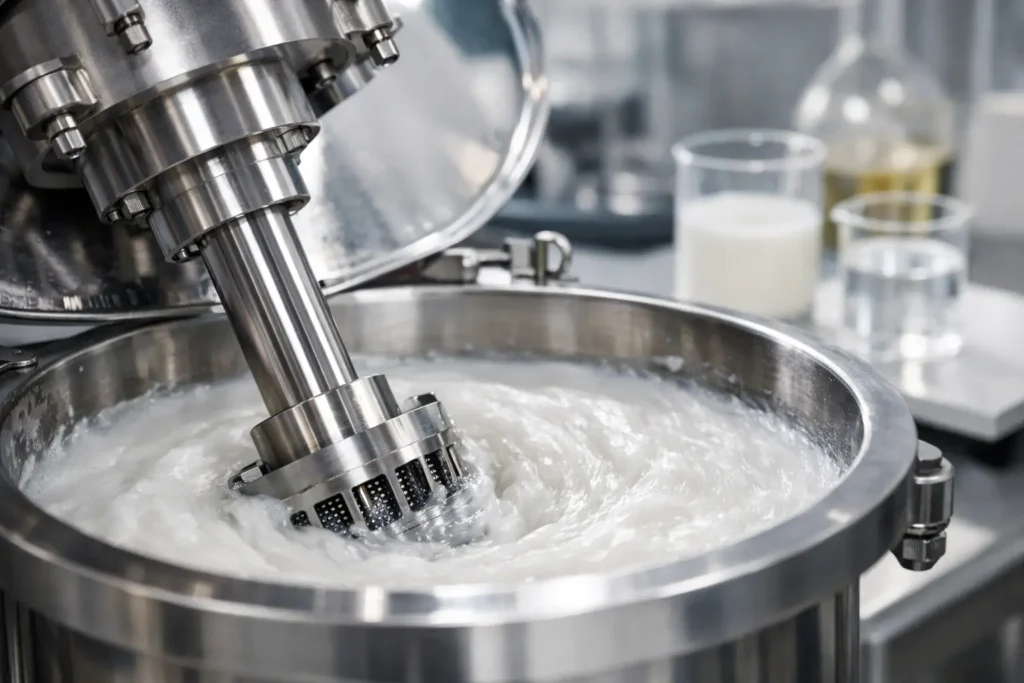
A stable emulsion rarely fails because of one dramatic mistake. More often, it drifts out of specification through small process mismatches – insufficient shear, poor ingredient addition, inconsistent temperature control, or a mixer that performs well in the lab but not on the plant floor. That is why selecting the right high shear mixer for emulsions is less about headline rotor speed and more about how the whole process behaves under production conditions.
In industrial manufacturing, emulsification is usually judged by the outcomes it delivers: droplet size distribution, stability over shelf life, appearance, mouthfeel or texture, batch repeatability, and throughput. The mixer sits at the centre of all of those requirements, but it cannot be assessed in isolation. Product rheology, vessel geometry, recirculation rate, heating and cooling duty, vacuum capability, and cleaning requirements all influence whether a system will perform consistently.
At its core, a high shear mixer creates intense mechanical energy in a localised zone, typically through a rotor-stator arrangement. As liquid and dispersed-phase materials pass through that zone, they are exposed to strong shear forces, turbulence, and pressure differentials that break droplets down and distribute them more evenly throughout the continuous phase.
That sounds straightforward, but in production it is rarely a single-pass event. Some formulations emulsify quickly and remain stable with modest energy input. Others need repeated circulation through the shear zone, tightly controlled ingredient dosing, and support from heating, vacuum deaeration, or anchor agitation to manage viscosity changes during the batch. A cosmetic cream, a flavoured emulsion, and an adhesive compound may all require high shear, but not in the same way.
For this reason, the right machine is not simply the one with the highest tip speed. It is the one that can generate the required shear consistently across the actual batch volume, while accommodating the product’s viscosity profile and the plant’s operating constraints.
Droplet size target is often the first technical checkpoint. If the application demands a fine, narrow droplet distribution, the mixer must provide sufficient energy density and circulation to reach that result within a practical batch time. Where a coarse or medium emulsion is acceptable, an over-specified system may add cost and process complexity without improving product performance.
Viscosity matters just as much. Many emulsions thicken during processing, particularly in creams, sauces, gels, and filled chemical systems. A bench-top result achieved in a low-viscosity early stage may not translate once the batch develops structure. In those cases, a high shear head alone may not maintain enough bulk movement, and a combined system with anchor agitation or a scraper mixer becomes more appropriate.
Temperature sensitivity is another deciding factor. Some emulsions require heating to melt waxes, fats, or functional solids before dispersion. Others are vulnerable to heat build-up caused by extended shear exposure. The mixer and vessel therefore need to be considered together, especially where jacketed heating and cooling are part of the process window.
Air management also deserves attention. Entrained air can compromise appearance, oxidation stability, density, and filling accuracy. In pharmaceutical, cosmetic, and food applications, vacuum emulsifying systems are often specified not as an extra feature but as a process necessity.
A common procurement risk is selecting equipment based on nominal vessel volume rather than usable process performance. Emulsification depends on circulation patterns, residence time in the shear zone, and the relationship between mixer head position and liquid level. A system that works well at one fill level may be less effective across a wider operating range.
Scale-up should therefore be approached with care. Linear assumptions rarely hold. Increasing vessel diameter, changing aspect ratio, or extending transfer lines can all affect shear exposure and batch time. Industrial buyers should look for suppliers who understand scale-up through application data, not just motor sizing tables.
This is usually one of the most important configuration decisions. A batch high shear mixer is often the preferred choice where formulations are viscous, process steps are sequential, or heating, cooling, and vacuum are integrated into one vessel. It gives good control over batch development and is well suited to creams, ointments, sauces, gels, and similar products.
An inline high shear mixer is often selected where continuous processing, rapid turnover, or aggressive recirculation is required. It can be highly effective for dispersing phases quickly and achieving repeatable results at larger throughputs. It may also reduce batch times in recirculation mode, particularly for lower to medium viscosity systems.
The trade-off is practical rather than theoretical. Inline systems can offer excellent shear efficiency, but they depend on the overall hydraulic design of the process. Pressure drop, pump behaviour, feed consistency, and pipework layout all influence performance. Batch systems can be easier to manage for variable recipes, but they may require additional agitation support as viscosity rises.
In many plants, the best answer is a hybrid arrangement: a vessel with sweep agitation and heating or cooling, combined with a recirculating inline high shear mixer. That approach can deliver both strong local shear and reliable bulk movement, especially in more demanding emulsification duties.
Mixer head design has a direct effect on results. Different rotor-stator geometries suit different duties, from rapid incorporation and coarse pre-emulsification to finer droplet reduction. Interchangeable heads can be valuable where one system must handle multiple products, but only if the changeover process is practical and validated within the site’s production regime.
Motor power should be judged in context. More power can support faster processing and heavier products, but usable performance depends on how efficiently energy is transferred into the product. Poor vessel design, dead zones, or weak recirculation can waste installed power.
For regulated sectors, construction and finish are not secondary concerns. Material contact parts, surface finish, seal design, and cleanability all affect hygiene and maintenance. In food, pharmaceutical, and cosmetics environments, clean-in-place capability, drainability, and gasket compatibility may be just as important as mixing intensity.
Where hazardous materials or solvents are involved, compliance becomes a central part of specification. ATEX requirements, solvent handling, inerting strategy, and seal selection should be addressed early. Retrofitting compliance features later is rarely efficient.
A well-engineered high shear mixer for emulsions should not only create shear but allow it to be controlled and repeated. Variable speed control, monitored batch timing, temperature feedback, vacuum control, and recipe-based automation all help reduce operator dependency.
That matters particularly when the same equipment is used across several SKUs or when production is transferred from one site to another. Repeatability is not just a quality issue. It affects waste, rework, changeover time, and overall line efficiency.
For many manufacturers, the most useful discussion is not simply about the mixer model but about the complete process sequence: when ingredients are charged, how powders or oils are introduced, when viscosity rises, whether deaeration is needed, and how the final product is discharged.
One frequent mistake is specifying purely by speed. High rpm does not automatically mean better emulsification if the mixer is too small for the vessel or if bulk flow is poor. Another is ignoring the full viscosity range of the batch. The process may start as a free-flowing liquid and finish as a highly structured emulsion that needs very different agitation support.
A further issue is underestimating cleaning and validation requirements. A mixer that performs well but is awkward to clean can become a production bottleneck. This is especially relevant where allergen control, product changeovers, or strict hygiene protocols apply.
It is also common to focus on first cost rather than lifecycle fit. Downtime, inconsistent batches, oversized batch times, or limited flexibility for future products can cost far more than the initial saving on equipment.
Food manufacturers may prioritise texture, hygienic design, and repeatable particle and droplet control. Cosmetic producers often need vacuum processing, smooth finish, and reliable handling of waxes and high-viscosity phases. Pharmaceutical and nutraceutical processors typically place greater emphasis on validation, containment, and process consistency. In specialty chemicals, the balance may shift towards solvent compatibility, hazardous-area compliance, and the ability to manage difficult rheology.
That variation is exactly why application-led specification matters. The same phrase – emulsion mixing – can describe very different process demands. A capable supplier should be able to discuss not only mixer type, but vessel design, thermal duty, automation level, and the likely trade-offs between batch time, fineness, flexibility, and capital cost.
For manufacturers reviewing new equipment, the most productive approach is to start with the product and process targets rather than the machine catalogue. Define what the emulsion must achieve, how the batch behaves from start to finish, and what constraints exist around hygiene, footprint, utilities, and compliance. From there, the right mixer configuration becomes much clearer.
PerMix UK works with manufacturers facing exactly these variables across food, cosmetics, pharmaceuticals, chemicals, and other process industries. The value is not in offering a generic answer, but in configuring mixing systems around the behaviour of the product and the realities of production.
A high shear mixer should do more than break droplets. It should support a stable, repeatable, commercially viable process – because on a production line, that is the result that actually counts.
Stay Connected