Industrial Mixers UK
PerMix News & Updates

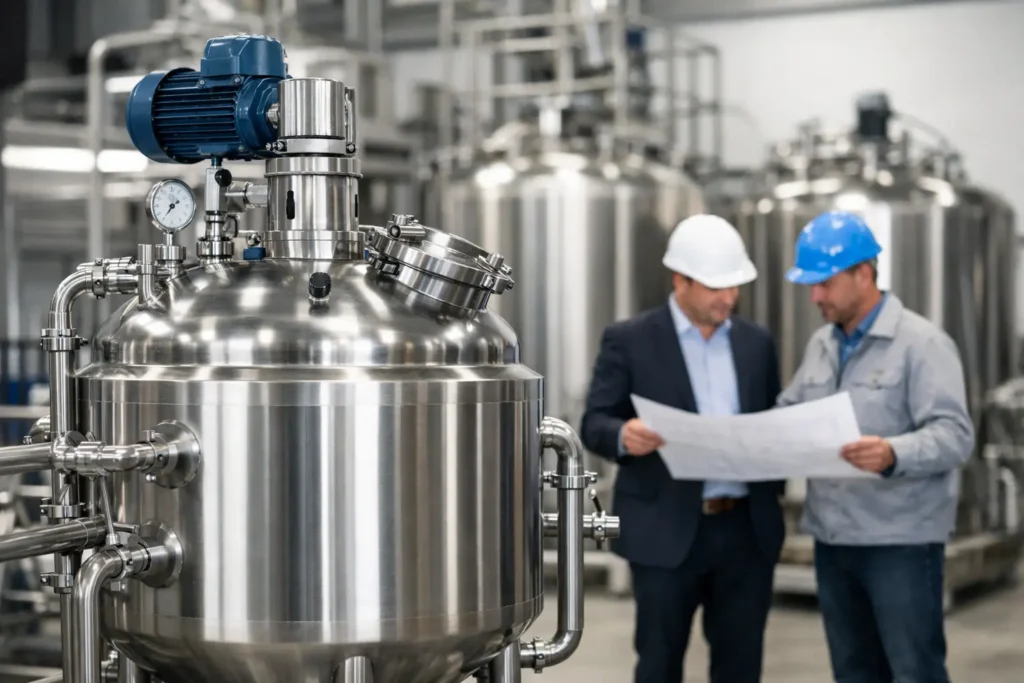
A jacketed mixing tank manufacturer is not simply supplying a vessel with an agitator and a heating or cooling layer around it. In most production environments, that tank sits at the centre of product quality, batch consistency, energy use and line reliability. If the specification is wrong, the consequences show up quickly – slow heat-up times, poor temperature uniformity, material build-up, extended cleaning cycles or a mixer that performs well in water trials but struggles with the actual product.
For technical buyers and process teams, the real question is not who can build a tank. It is who can engineer the right tank, agitator, jacket arrangement and control package for the product, process duty and production constraints you are working with.
The term covers a wide range of equipment. In one plant, a jacketed vessel may be used to heat a low-viscosity syrup before filling. In another, it may cool a shear-sensitive cosmetic cream, hold fermentation temperatures within a narrow range, or manage a reactive chemical process under vacuum. The basic architecture looks similar, but the process demands are not.
A capable jacketed mixing tank manufacturer should therefore start with application data rather than catalogue dimensions. Product viscosity, density, solids loading, batch size, target temperature ramp, utility availability, cleanability requirements and site layout all influence the final design. When these details are treated as secondary, the result is often an acceptable vessel with poor process performance.
The strongest manufacturers work backwards from the required outcome. That means understanding whether the priority is heat transfer, blend uniformity, powder incorporation, gentle agitation, deaeration, hygienic design or hazardous-area compliance. In many cases, it means balancing several of these requirements at once.
Tank volume is usually the first figure discussed, but it is rarely the most important. A 1,000-litre vessel processing a high-viscosity adhesive behaves very differently from a 1,000-litre vessel mixing a beverage base. The agitator geometry, motor power, shaft support, baffle arrangement and jacket design may all change substantially.
This is where supplier capability becomes visible. A general fabricator may be able to manufacture the shell, but industrial users need confidence that the equipment has been designed for the rheology and thermal behaviour of the actual product. Heat transfer calculations, agitator selection and mechanical design should be tied to the process, not applied as standard assumptions.
For food, pharmaceutical and cosmetics production, hygienic construction is equally central. Surface finish, weld quality, dead-leg avoidance, seal design and drainability directly affect cleaning effectiveness and validation. In chemical and specialty materials applications, the emphasis may shift toward pressure ratings, corrosion resistance, inerting, solvent compatibility or ATEX-related requirements. Good manufacturers do not force these sectors into one standard design language.
The quality of supplier engagement often becomes clear through the questions they ask. A serious engineering-led manufacturer will want to know how the product behaves across temperature, not just at room conditions. They will ask whether solids settle, whether viscosity rises during cooling, whether foam is an issue, and whether air entrainment affects downstream filling or reaction performance.
They should also examine the thermal side in detail. Is the jacket intended for heating, cooling or both? Are you using steam, hot water, thermal oil or chilled water? What ramp rate is acceptable, and how critical is temperature uniformity across the batch? A vessel that can technically heat a product may still be unsuitable if it scorches localised areas or cannot remove heat quickly enough during a reaction.
Control philosophy matters as well. Some operations need simple on-off temperature control and fixed-speed mixing. Others require recipe management, variable speed drives, vacuum operation, load cells, automated valve sequencing and integration with a wider PLC or SCADA environment. The right manufacturer should be able to match the level of automation to the process and the plant standard, rather than overspecifying or stripping the system back too far.
Many performance issues in jacketed tanks are caused less by the vessel itself than by the wrong mixing technology. Anchor agitators suit viscous products and improve wall-sweeping heat transfer, but they are not ideal for every duty. High-shear mixers can accelerate dispersion and emulsification, though they may introduce unwanted shear or temperature rise. Propellers and pitched blade turbines work well for lower viscosities, while multi-stage systems may be needed when the batch changes character during processing.
A manufacturer with a broad mixing portfolio is often better placed to specify correctly because it is not limited to one agitator style. In practice, many applications need a combination – for example, an anchor for bulk movement and heat transfer, paired with a rotor-stator head for dispersion.
Not all jackets perform the same way. Conventional outer jackets, dimple jackets and half-pipe coil arrangements each offer different advantages in terms of pressure handling, heat transfer and fabrication complexity. The best option depends on the utility medium, operating conditions and vessel geometry.
This is another area where generic specifications can create problems. A tank may meet the drawing requirements yet still deliver poor heating efficiency or unstable cooling performance in operation. Manufacturers that model heat transfer requirements properly are more likely to prevent these issues before the vessel reaches site.
Industrial buyers in the UK and Europe are rarely purchasing on mechanical fit alone. Material certificates, conformity, hygienic standards and safety documentation are all part of the decision. A jacketed mixing tank manufacturer should be able to specify suitable grades of stainless steel or alternative alloys, document finish requirements and advise on gasket and seal materials compatible with both product and cleaning chemistry.
In regulated sectors, design for inspection and validation can be as important as throughput. CIP capability, spray device coverage, full drainability and traceable fabrication standards reduce operational risk over the long term. In solvent or dust-risk environments, hazardous-area compliance must be addressed at system level, covering motors, instrumentation and control components rather than treated as an afterthought.
There is also a practical commercial point here. Well-documented equipment tends to move through procurement, quality review and site acceptance more smoothly. Delays often come from missing technical detail, not from manufacturing lead time alone.
There is no single right answer here. Standard jacketed tanks can be cost-effective and fast to supply where the duty is straightforward, utilities are conventional and site integration is simple. They are often the right choice for established processes with stable parameters.
Bespoke design becomes more valuable when the process is difficult, the product range is broad, floor space is constrained or the system must integrate with upstream and downstream equipment. That may include vacuum mixing, powder induction, load cells, platform access, transfer pumps, inline recirculation or multi-vessel skids.
The key is whether customisation improves production performance enough to justify the added engineering and capital cost. Experienced manufacturers will be candid about that trade-off. Not every process needs a heavily customised solution, but many benefit from more than a standard vessel with optional extras attached.
A strong technical specification is essential, but so is confidence in the supplier behind it. Industrial users should look at how the manufacturer handles application review, drawing approval, fabrication standards, testing, factory acceptance and after-sales support. Responsiveness during the quotation stage often tells you a great deal about how the project will run once the order is placed.
It also helps to assess whether the supplier understands your sector. Food and beverage, pharmaceuticals, adhesives and battery materials may all use jacketed tanks, but the process risks and compliance expectations are very different. A manufacturer with cross-sector experience can bring useful perspective, provided that experience is translated into application-specific design rather than generic claims.
For many buyers, the best partner is one that can support both standard and engineered systems across liquid, paste and high-viscosity duties. That wider process knowledge tends to produce better decisions on mixing, heating, cooling and automation. PerMix UK operates in that space, combining a broad equipment range with application-led engineering for demanding production environments.
When you are comparing suppliers, the most useful test is simple. Ask how they would adapt the design if your product became thicker at the end of the batch, if your utility temperature changed, or if you needed to clean more quickly between campaigns. A dependable jacketed mixing tank manufacturer will answer with engineering logic, not sales language.
The right tank should do more than hold product and hit a temperature setpoint. It should make the process easier to control, easier to clean and easier to scale with confidence.
Stay Connected