Industrial Mixers UK
PerMix News & Updates

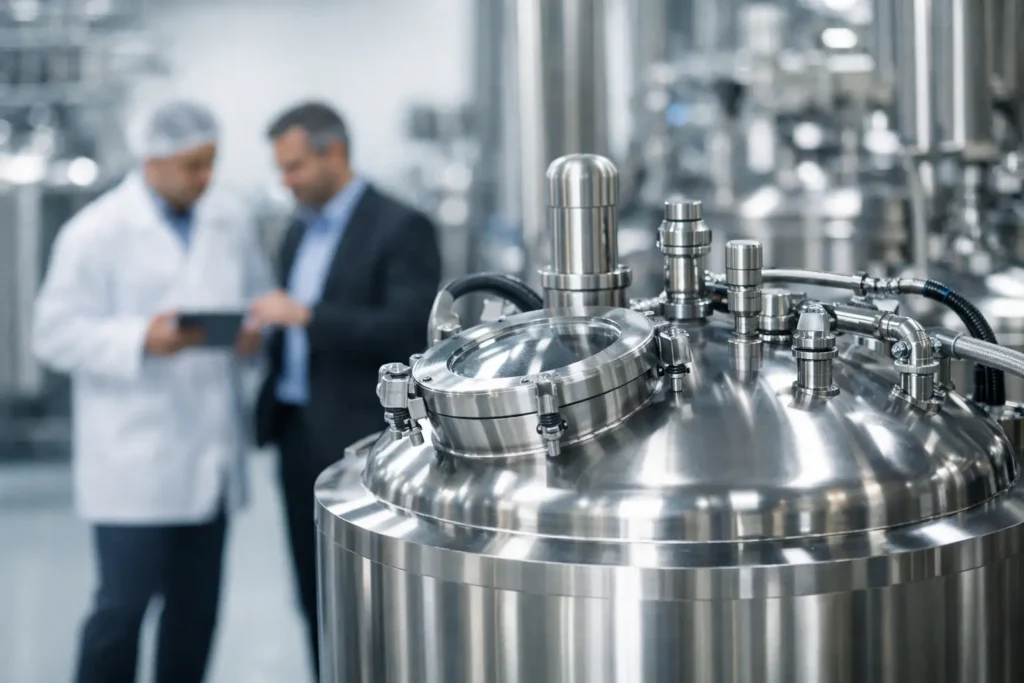
A stainless steel process vessel is rarely just a tank. In most production environments, it sits at the point where product quality, throughput, hygiene, temperature control and operator safety all meet. If the vessel is poorly specified, those issues show up quickly – inconsistent batches, slow heat transfer, cleaning delays, product retention, or integration problems with upstream and downstream equipment.
For manufacturers working with powders, liquids, pastes or reactive formulations, vessel selection needs to be tied to the process rather than treated as a standard purchasing exercise. The right design depends on what is happening inside the vessel, how the product behaves, and what the wider plant requires in terms of compliance, control and maintainability.
At a basic level, a stainless steel process vessel contains material during production. In practice, it often has a much wider role. It may need to support mixing, blending, homogenising, heating, cooling, vacuum processing, pressure operation, deaeration, fermentation, crystallisation or reaction control. In many systems, the vessel is also expected to provide a hygienic product contact surface, withstand repeated cleaning cycles and integrate with load cells, instrumentation, dosing systems and automation.
That is why vessel specification starts with duty. A holding tank for a low-viscosity liquid is a very different proposition from a jacketed vessel handling high-viscosity adhesive under vacuum, or a hygienic reactor for temperature-sensitive food ingredients. Material state, viscosity, density, solids loading, shear sensitivity and batch size all affect the final design.
Material selection is usually the first technical discussion, and rightly so. Stainless steel remains the default choice across food, pharmaceutical, cosmetic and chemical processing because it offers corrosion resistance, mechanical durability and cleanability. The most common grades are 304 and 316 stainless steel, but the correct choice depends on product chemistry, cleaning regime and operating conditions.
For less aggressive duties, 304 may be suitable and commercially efficient. Where chlorides, acidic ingredients, saline formulations or more demanding washdown conditions are present, 316 often provides the better margin of protection. This is particularly relevant in hygienic sectors where long equipment life and surface integrity matter as much as initial cost.
Surface finish should not be treated as a cosmetic detail. Internal finish affects cleanability, product retention and contamination risk. A smoother finish may be necessary for pharmaceutical, nutraceutical and high-care food production, while a more standard finish can be acceptable in less sensitive industrial applications. The trade-off is straightforward: tighter finish requirements can increase capital cost, but they can also reduce cleaning time and improve compliance.
A vessel should be designed from the inside out. The geometry, internal fittings and thermal features all need to match the actual process duty.
If the vessel is part of a mixing system, impeller type, mixer position and vessel shape need to work together. Anchor agitators, high shear mixers, dispersers, propellers and multi-shaft arrangements all impose different demands on head design, shaft support, baffle arrangement and torque capacity. A vessel designed without regard to agitation often performs poorly once installed, even if the mixer itself is correctly chosen.
High-viscosity products may require conical, dished or custom-bottom geometries to support discharge and minimise dead zones. Low-viscosity applications may prioritise circulation, suspension or blending speed. Where powders are introduced into liquids, the vessel must also account for wet-out behaviour, dust control and the risk of lump formation.
Many stainless steel process vessels are expected to do more than hold and mix. They must also control temperature with enough precision to support product quality and cycle time. Jackets, limpet coils and insulated constructions are commonly used, but the right thermal arrangement depends on utility availability, viscosity, allowable heating rates and product sensitivity.
Rapid heating sounds attractive, but it is not always beneficial. Some materials scorch or degrade at the wall if localised temperatures are too high. Cooling presents similar challenges, especially with viscous products where heat transfer becomes less efficient as flow near the vessel wall slows. In these cases, the combined design of agitator, vessel wall and thermal system determines whether the process is efficient or frustratingly slow.
Vacuum processing is common where deaeration, solvent removal, density control or oxidation reduction is required. Pressure-rated vessels may be necessary for reaction processes, petrol blanketing or transfer conditions. These duties materially affect shell thickness, reinforcement, seal design, inspection requirements and compliance documentation.
This is one area where under-specification becomes expensive. A vessel that appears suitable for atmospheric duty cannot simply be adapted later for vacuum or pressure service without broader mechanical and regulatory implications.
In regulated sectors, hygienic design is not optional. The vessel must support reliable cleaning and inspection while reducing the risk of contamination, residue build-up and microbial growth. That means attention to weld quality, drainability, internal crevices, gasket selection, spray device placement and valve configuration.
Clean-in-place capability is often a practical requirement rather than a preference. If batches are frequent and product changeovers are common, cleaning downtime becomes a production issue as much as a quality issue. The best vessel design is not only easy to clean when new, but remains serviceable after years of operation, repeated thermal cycling and exposure to aggressive detergents.
Compliance requirements vary by industry and installation. Food and pharmaceutical users may focus on hygienic construction and validation support, while chemical manufacturers may place more emphasis on pressure design codes, hazardous-area requirements and material traceability. A dependable supplier should be able to align the vessel specification with the relevant standards rather than offering a one-size-fits-all build.
The headline specification never tells the whole story. In operation, smaller design choices often have the greatest effect on reliability and usability.
Nozzle layout is a good example. Top-entry connections, side inlets, manways, venting, sampling points and instrument ports need to suit both the process and the plant footprint. Poor nozzle placement can make maintenance awkward, reduce usable volume or interfere with mixer performance. Likewise, discharge arrangement matters. A vessel that drains slowly or leaves significant heel volume can create waste, cleaning burden and batch inconsistency.
Support structure is another detail with wider implications. Skirt-mounted, leg-mounted and frame-mounted vessels each suit different layouts and loading conditions. If load cells are required for batch control, the support design must account for weighing accuracy as well as mechanical stability. If the vessel sits in an existing line, access constraints, ceiling height and service routing need to be resolved early rather than after fabrication begins.
Controls should also be considered at specification stage. Temperature probes, pressure transmitters, level sensing, recipe control and mixer interlocks are not add-ons in a modern plant. They are part of how the vessel delivers repeatable production.
There are applications where a standard vessel is entirely appropriate. For straightforward storage or simple mixing duties, standardisation can reduce lead time and cost. But once the process includes vacuum, heating and cooling, higher viscosities, hygienic demands, hazardous-area classification or non-standard batch sizes, bespoke engineering often becomes the more commercially sensible route.
That does not necessarily mean complexity for its own sake. It means matching the vessel to the duty so that the finished system performs correctly from the start. PerMix UK typically sees the strongest long-term results where vessel design is developed alongside mixer selection, utility conditions, control strategy and plant integration requirements rather than treated as an isolated component purchase.
When comparing options, buyers should look beyond vessel volume and base material. The more useful questions are operational. Will the vessel process the full viscosity range expected in production? Can it heat and cool within the required cycle time? Is the internal finish appropriate for the cleaning regime? Does the design support safe maintenance access? Are compliance documents, test records and fabrication standards clear?
It is also worth testing assumptions around future use. Production rarely stands still. A vessel chosen for today’s formulation may need to handle product extensions, tighter hygiene controls or higher output in two years’ time. Building in sensible flexibility can be more cost-effective than replacing underperforming equipment later.
A stainless steel process vessel should ultimately make the process more stable, more controllable and easier to run. If the specification is built around the real production duty, it becomes an asset rather than a constraint. That is the standard worth aiming for when the vessel will sit at the centre of your operation.
Stay Connected