Industrial Mixers UK
PerMix News & Updates

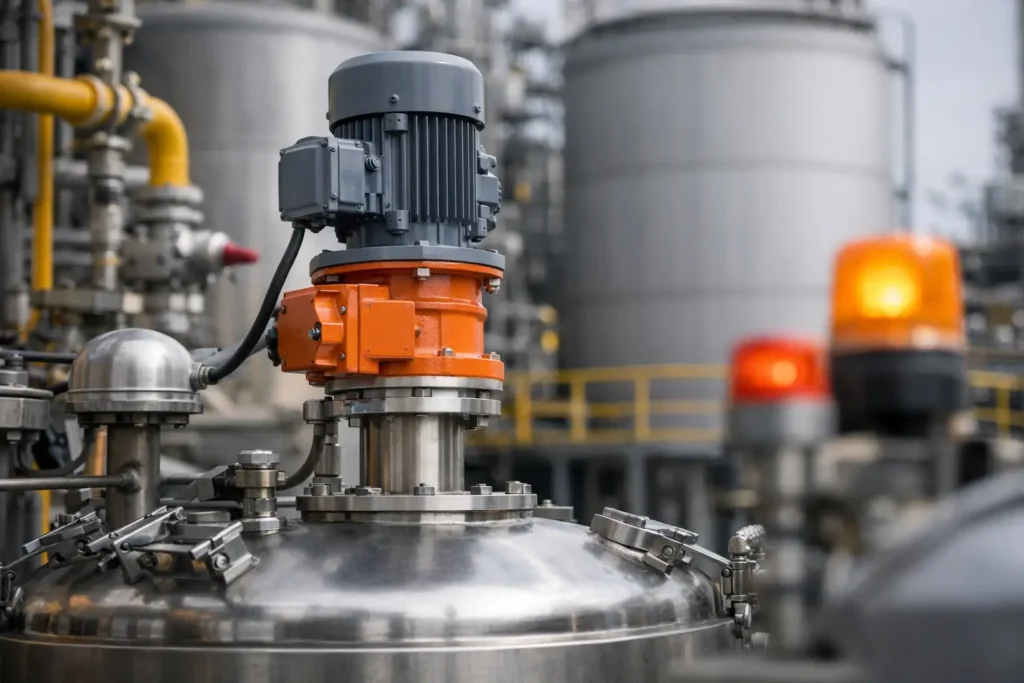
A mixer specified for a hazardous area can look perfectly adequate on paper and still be wrong for the process. That usually happens when ATEX is treated as a motor selection exercise rather than a system-level engineering requirement. An ATEX compliant industrial mixer has to suit the product, the zone classification, the process conditions and the way the equipment will actually be operated and cleaned.
For manufacturers handling solvents, fine powders, volatile ingredients or combustible dusts, the stakes are obvious. The wrong configuration can create ignition risk, production delays, difficult maintenance and expensive redesign work later in the project. The right one supports safe operation without compromising batch quality, throughput or cleanability.
ATEX compliance is about equipment intended for use in potentially explosive atmospheres. In practice, that means the mixer cannot be considered in isolation. The drive, gearbox, seals, instrumentation, control panel, earthing arrangement, surface temperatures and even the way product is charged and discharged all need to be considered against the classified area.
This matters because hazardous area duty is not limited to chemical plants. Food ingredients, nutraceutical powders, milk powders, starches, sugar, resins, solvents, ethanol-based products, coatings, adhesives and battery materials can all introduce explosive atmospheres under the right conditions. Dust and vapour hazards behave differently, and a mixer that is suitable for one is not automatically suitable for the other.
A sound specification starts with the area classification. Zone 0, 1 and 2 apply to gases, vapours and mists. Zone 20, 21 and 22 apply to combustible dusts. The frequency and duration of the hazardous atmosphere affects the equipment category and protection concept required. That assessment should then be matched to the actual mixing duty, because torque, speed, viscosity, fill level and heat generation all influence safe design.
Two plants may both request an ATEX-rated mixer for a Zone 21 area, yet need very different machines. One may be blending free-flowing powder with low energy input. The other may be dispersing cohesive material with high shear, elevated temperature and long batch times. Treating those applications as equivalent often leads to over-simplified equipment choices.
The process determines more than mixing performance. It also affects mechanical loading, seal wear, potential for static build-up, the likelihood of product accumulation and the thermal profile of the machine in operation. High-viscosity paste mixing, for example, can place significant stress on the drive train and may require anchor, sigma or multi-shaft configurations designed for controlled movement of dense material. Powder blending may call for gentle, low-friction mixing with careful attention to clearances and internal finishes.
That is why experienced buyers usually review hazardous area compliance and process design together. A technically correct ATEX classification is only part of the answer if the mixer itself cannot deliver consistent dispersion, prevent dead spots or integrate with upstream and downstream handling equipment.
The most reliable specifications begin with the product and the environment, not the catalogue. Material state is the first decision point. Powders, liquids and pastes each present different ignition and handling considerations, and those differences shape the mixer type.
For powder applications, the central questions are usually dust explosibility, particle behaviour, filling method and containment. Ribbon blenders, paddle mixers, ploughshare mixers and vertical systems can all be engineered for hazardous areas, but the final choice depends on blend uniformity, fragility, batch cycle time and cleaning regime. Dust-tight construction, effective earthing and control of mechanical friction are particularly important.
For liquid processing, solvent content, flash point, vapour generation and vessel design come into sharper focus. Top-entry, bottom-entry and inline high shear mixers may all be viable, but the seal arrangement, motor protection, controls and temperature management need careful review. If the process involves heating, cooling or vacuum, that has to be considered as part of the complete system rather than added later.
For pastes and highly viscous products, the challenge is often balancing safe operation with enough mechanical energy to move the mass effectively. Double planetary mixers, sigma mixers and multi-shaft dispersers are common answers, but torque demand, start-up load and heat development must be assessed properly. In these applications, a nominally compliant drive package is not enough if the mixer geometry creates localised overheating or poor material turnover.
Hazardous area projects are often won or lost in the detail. Earthing and bonding are obvious requirements, but they are not the only ones. Surface finish and internal geometry influence product build-up. Seal selection affects vapour containment and maintenance intervals. Bearing arrangement can affect reliability in continuous or high-load operation.
Electrical integration deserves the same level of attention. Instrumentation, load cells, temperature probes, speed sensors and control interfaces may all need to meet the relevant area classification. If the mixer is supplied as part of a larger package with vessel, platform, discharge system and controls, the boundary of responsibility needs to be clear from the start.
There is also a practical point here for procurement teams. A lower initial price can become expensive if site integration reveals that the panel, sensors or ancillaries have been specified to a different standard from the mixer itself. Consistency across the full package usually reduces both commissioning risk and handover delays.
In food, pharmaceutical, cosmetic and nutraceutical production, buyers sometimes assume they must compromise between hygienic design and hazardous area compliance. In practice, both can and should be addressed together.
An ATEX compliant industrial mixer used in hygienic production may still require polished contact surfaces, CIP or WIP capability, reduced crevice design, suitable gasket materials and controlled discharge geometry. If the product changes frequently, clean-down time becomes a commercial issue as well as a technical one. A safe mixer that is slow to clean can reduce line utilisation just as surely as an under-sized drive can reduce throughput.
The same applies to validation-sensitive environments. Equipment should be designed so that compliance measures do not make inspection, cleaning or maintenance unnecessarily difficult. This is where application-led engineering adds value, because the best answer is usually a coordinated design rather than a collection of isolated compliance features.
The first mistake is specifying by zone alone. Area classification is essential, but it does not tell you what impeller, shear level, vessel geometry or discharge arrangement the process requires.
The second is assuming the motor determines the whole compliance picture. In reality, ignition risk can be influenced by rotating parts, seals, bearings, controls, static discharge and temperature rise across the system.
The third is overlooking the material itself. A process may evolve over time, especially where formulations change or production scales up. If solvent content increases, dust characteristics vary or batch temperatures shift, the original specification may no longer reflect the actual operating envelope.
A further issue is failing to account for maintenance access. Hazardous area equipment that is difficult to inspect or service can lead to longer stoppages and more complicated permit requirements. For many plants, maintainability is not secondary to compliance. It is part of how compliance is sustained over the life of the asset.
The most effective projects usually begin with a technical discussion, not a product code. Buyers should expect to define the material characteristics, batch size, viscosity or bulk density, operating temperature, pressure or vacuum conditions, area classification, cleaning method and required level of automation. From there, the mixer technology can be narrowed down with far more confidence.
This is especially valuable where the application sits between standard categories. A process may involve wetting powders into solvents, dispersing solids into viscous binders, or heating and cooling under vacuum in the same vessel. Those duties often need bespoke engineering rather than an off-the-shelf mixer with an ATEX label attached. PerMix UK typically approaches these applications by aligning mixer type, vessel design and hazardous area requirements as one package, which is usually the more reliable route for complex production environments.
For engineering teams and technical buyers, the key point is simple. ATEX compliance should support process performance, not sit alongside it as a separate box to tick. When the specification is built around the real product, the real plant conditions and the real duty cycle, the result is safer, easier to operate and more likely to deliver stable production over time.
If you are reviewing a new installation or replacing an existing mixer in a classified area, it is worth slowing the process down long enough to ask the difficult questions early. That is usually where the best equipment decisions are made.
Stay Connected