Industrial Mixers UK
PerMix News & Updates

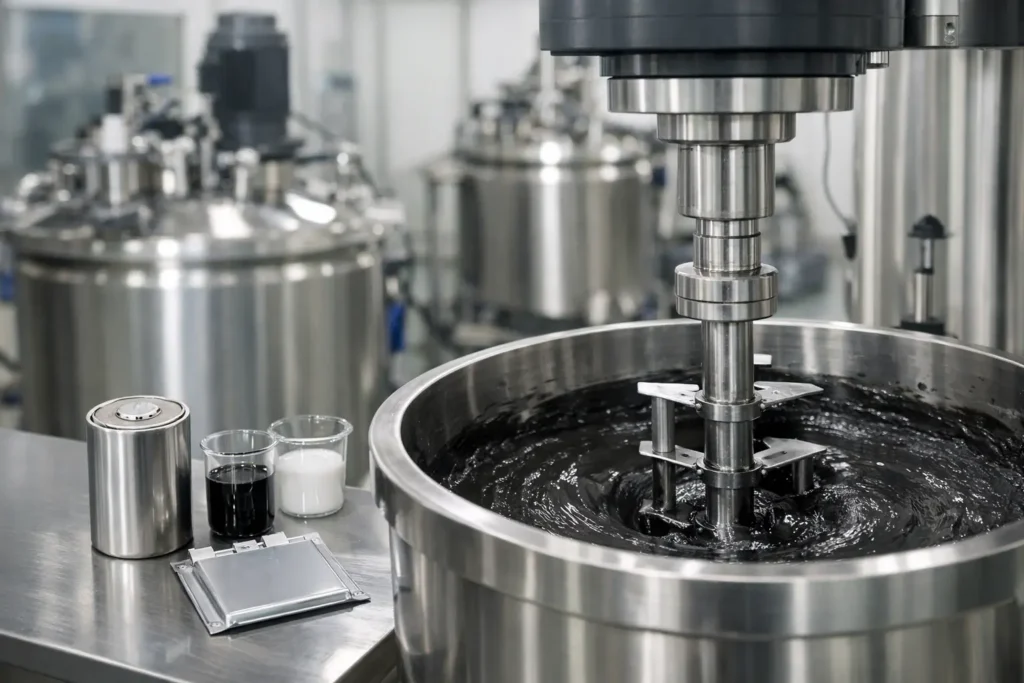
A battery line can tolerate many variables, but slurry inconsistency is rarely one of them. When solids are not fully wetted, conductive additives are poorly dispersed, or entrained air remains in the mix, the effect shows up downstream in coating quality, drying behaviour and final cell performance. That is why battery slurry mixing equipment deserves careful specification at the earliest stage of process design.
For manufacturers producing anode and cathode formulations, mixing is not simply a matter of combining powders and liquids. It is a controlled process of wetting, dispersing, homogenising and, in many cases, deaerating materials with very different particle sizes, densities and rheological behaviours. The right equipment must handle this complexity repeatedly, at production scale, and within the constraints of safety, cleanliness and throughput.
Battery slurries place unusual demands on process machinery. Active materials, binders, conductive carbon and solvents must be blended into a stable, uniform system that can be coated consistently. In practice, that means the mixer must generate enough shear to break down agglomerates and distribute fine solids, but without creating avoidable heat build-up or damaging sensitive material structures.
Viscosity is often a moving target throughout the batch cycle. A formulation may begin as a low-viscosity liquid phase, then thicken rapidly as powders are introduced and binder systems develop. Some processes benefit from staged addition under vacuum; others require precise control of temperature and order of addition to prevent lumping or incomplete wet-out. Equipment selection therefore depends not only on final viscosity, but also on how the slurry behaves from start to finish.
This is where industrial buyers need to look beyond nominal batch volume or motor size. The real question is whether the mixer geometry, shear profile and vessel design are matched to the process objective.
There is no single answer for battery slurry mixing equipment because the best choice depends on chemistry, batch size, solvent system and production strategy. Even so, several equipment categories are commonly considered.
High shear mixers are often used where rapid dispersion and powder incorporation are critical. They are particularly effective for wetting fine powders and reducing agglomerates in formulations that need strong localised shear. For some battery applications, this can shorten batch times and improve dispersion quality.
The trade-off is that high shear alone may not always provide ideal bulk movement in very high-viscosity systems. If the slurry thickens substantially during processing, vessel design and supplementary agitation become more important. Heat generation must also be watched closely, especially where solvent handling and temperature-sensitive binders are involved.
Planetary mixers are widely used for medium to high-viscosity pastes and slurries where thorough bulk movement is required alongside strong mixing action. Their mixing tools move through the vessel while rotating on their own axes, helping to sweep the full batch and reduce dead zones.
For battery compounds, this style of mixer is often attractive when the process involves heavy solids loading, progressive viscosity increase and the need for dependable batch uniformity. When configured with vacuum capability, it can also assist with deaeration, which is valuable in reducing foam, trapped air and coating defects.
Multi-shaft systems combine different agitator types in a single vessel, such as a high-speed disperser with anchor or low-speed mixing elements. This arrangement gives process engineers more flexibility across different batch stages. High shear can be applied during dispersion, then slower agitators maintain turnover and temperature control as viscosity rises.
This approach suits manufacturers who need a broader process window or who handle multiple slurry formulations on the same line. The benefit is versatility; the compromise is greater system complexity and, in some cases, a larger footprint or more involved cleaning routine.
In battery slurry production, the mixer itself is only part of the answer. Vessel configuration, pressure control and thermal management have a direct effect on product quality.
Vacuum processing is often specified to reduce entrained air and support powder incorporation. Air in the slurry can disrupt density control, create coating issues and affect downstream performance. Applying vacuum during or after mixing can improve homogeneity, but it must be engineered correctly around seal design, solvent compatibility and safe operation.
Temperature control is equally important. Mixing energy, binder hydration or solvent interaction can all change slurry temperature during the batch. A jacketed vessel with heating or cooling capability helps maintain a tighter process window. This becomes especially relevant where viscosity is temperature-dependent or where excessive heat could alter material behaviour.
Vessel geometry also deserves close attention. The ratio of height to diameter, internal finishes, baffle arrangement and discharge design all influence batch movement and clean discharge. In production settings, poor vessel design can undermine a good mixing head.
The most effective way to specify battery slurry mixing equipment is to start with the process, not the catalogue. Chemistry, rheology and plant requirements should drive the decision.
Powder characteristics matter immediately. Fine conductive carbons behave very differently from heavier active materials, and both differ again from binder powders prone to fisheyes or lump formation. A system that handles one material package well may struggle with another.
Solids loading is another key factor. Higher solids content usually increases demand for torque, bulk movement and controlled addition. If the process is designed to push concentration limits for energy density or coating efficiency, the mixer must cope with these conditions without stalling, overworking the batch or extending cycle time beyond practical limits.
Batch size and scale-up strategy are just as important. A laboratory mixer can produce excellent samples, but scale-up often fails when shear intensity, residence time or vessel proportions change too much. Industrial buyers should look for equipment designs with predictable scale-up principles rather than assuming a larger machine will behave the same way.
Automation may also influence the specification. For many plants, the best solution includes controlled ingredient charging, recipe management, vacuum sequencing, temperature monitoring and integration with upstream or downstream handling equipment. This is especially relevant where traceability, batch repeatability and operator safety are priorities.
One common mistake is selecting purely on final viscosity. A slurry that ends at a moderate viscosity may still pass through a difficult dispersion stage where powder wetting and agglomerate breakdown are the real bottlenecks. Another is focusing on speed without considering tip speed, shear zone design and overall batch turnover.
Underspecifying vacuum capability is another frequent issue. If deaeration is essential to product quality, it should not be treated as an optional extra added late in the project. The same applies to solvent compatibility, ATEX considerations where relevant, and the practicalities of cleaning between campaigns.
There is also a tendency to underestimate discharge behaviour. Battery slurries can be difficult to empty cleanly, particularly at high viscosity. Poor discharge design leads to product loss, extended cleaning and inconsistent batch transfer to storage or coating systems.
A credible supplier should be able to discuss more than motor power and vessel volume. The better conversation covers material behaviour, order of addition, desired dispersion quality, thermal control, vacuum level, batch cycle time and scale-up route.
It is also worth asking how the equipment can be configured for your site. That may include jacketed vessels, load cells, automation architecture, safety interlocks, solvent-rated seals, cleanability requirements and integration with transfer systems. For many manufacturers, a standard machine is only the starting point.
This is where an engineering-led supplier adds value. PerMix UK, for example, works across a broad range of mixing technologies and process vessel designs, which is useful when the application does not fit neatly into a single equipment category. In battery processing, that flexibility matters because performance depends on matching the mixer to the formulation rather than forcing the formulation to suit the mixer.
The best battery slurry mixing equipment is not necessarily the most aggressive or the most complex. It is the system that delivers repeatable dispersion, controlled rheology, reliable deaeration and practical throughput under real production conditions. That may point to a high shear mixer, a planetary mixer, a multi-shaft system, or a bespoke arrangement built around the specifics of the process.
For technical buyers and process engineers, the decision should be grounded in testing, scale-up logic and a realistic view of plant operation. When mixing is specified properly, it supports the entire line – from slurry preparation to coating consistency and batch-to-batch quality. That is usually where the strongest return is found: not in buying the biggest machine, but in buying the right one for the chemistry, the factory and the production target ahead.
Stay Connected