Industrial Mixers UK
PerMix News & Updates

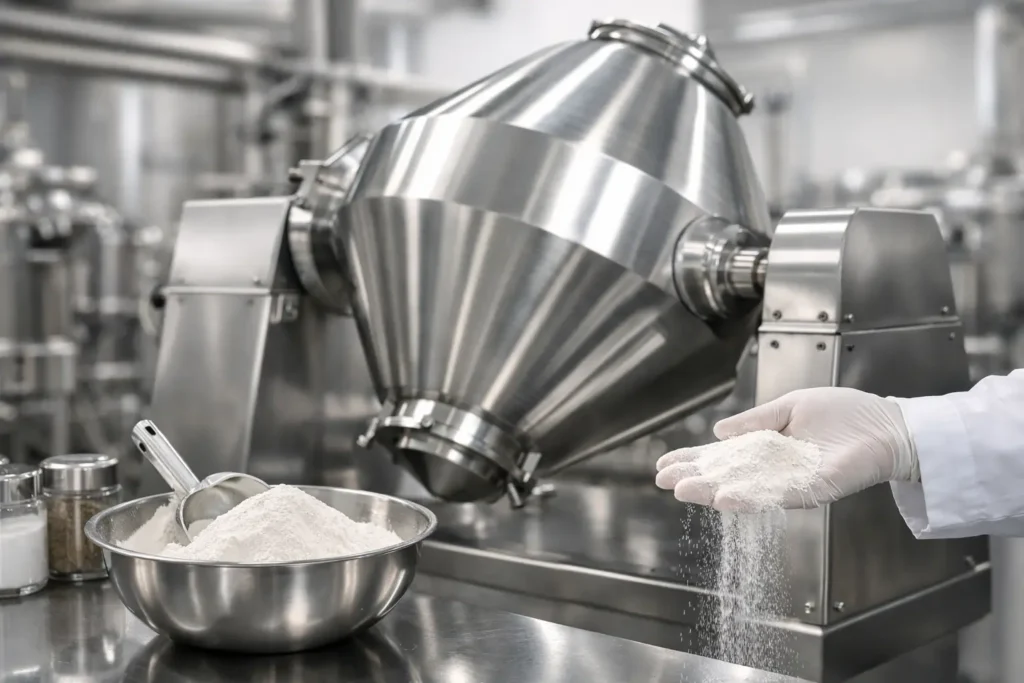
A seasoning blend that looks uniform in the discharge sample can still fail on the line. Fine ingredients may segregate in transfer, fat-coated powders may smear onto the vessel wall, and trace additions can drift outside specification if the mixer is not matched to the product. That is why selecting a food grade powder mixer is less about buying a generic machine and more about engineering for the behaviour of the material, the hygiene standard and the production target.
In food manufacturing, powder mixing is rarely a standalone step. It sits between raw material handling, sieving, dosing, transfer, packing or downstream wet processing. The mixer therefore has to do more than create an acceptable blend. It must deliver repeatable batch quality, support cleanability, protect sensitive ingredients and fit within the realities of plant layout, operator access and validation requirements.
At a basic level, a food grade powder mixer must achieve homogeneous blending without damaging the product or creating unnecessary cleaning burden. In practice, that means the specification needs to address several variables at once.
Hygienic design is the first filter. Product-contact surfaces should be suitable for food production, with appropriate finishes, weld quality and geometry to reduce retention points. Depending on the application, the machine may need full stainless steel construction, polished internal surfaces, food-grade seals, easy-access doors and discharge arrangements designed to minimise hold-up. If allergen control or frequent recipe changeovers are part of the process, clean-down time becomes commercially significant, not just a maintenance detail.
Blend performance is the second. Some food powders free-flow easily and mix quickly. Others do not. Ingredients with different particle sizes, bulk densities or fat contents can behave unpredictably. A machine that works well for flour and sugar may not be the right answer for spice premixes, protein powders or powdered beverage formulations with micro-ingredients. Uniformity targets, batch size and required cycle time all shape the right mixer choice.
Then there is process integration. The mixer may need to accept manual bag tipping, bulk bag discharge, vacuum conveying or automated ingredient feeding. It may need load cells, recipe control, sampling ports, lump breaking, jacketed temperature control or downstream discharge into hoppers, screw conveyors or filling systems. For many manufacturers, the value lies in how well the mixer supports the entire process, not only what happens inside the vessel.
There is no single best mixer for every food powder. The right technology depends on the material and the production objective.
Ribbon blenders remain a common choice for many dry food products. They are well suited to relatively free-flowing powders and granules where efficient convective mixing is required over medium to large batch volumes. They are often used for bakery premixes, beverage powders, seasoning blends and other products where ingredient distribution is important but the formulation is not especially fragile.
Their strength is practicality. They can offer good throughput, straightforward loading and discharge, and a familiar operating profile for production teams. They can also be configured with spray systems for controlled liquid addition, though the amount and viscosity of liquid that can be incorporated will depend on the formulation. Where smearing, caking or build-up is likely, internal geometry and cleaning access need closer attention.
Paddle mixers are often selected where quicker blend times, lower shear and more fluidised product movement are beneficial. They can perform well with fragile particulates or formulations where ingredient damage and heat build-up need to be limited. In food processing, that can make them attractive for cereal blends, nutraceutical powders and products containing inclusions that should remain intact.
They are also frequently chosen when moderate liquid addition is required. The mixing action can help distribute oils, flavours or other liquid ingredients across the batch without creating excessive localised wetting. That said, not every paddle mixer suits every sticky application. If the product has a strong tendency to coat surfaces, further evaluation is usually needed.
Tumble blending technologies, including V and double-cone designs, are used when gentle movement and low shear are the priority. These are often associated with powders that mix well through repeated division and recombination rather than aggressive agitation. In food and nutraceutical applications, they can suit dry blends where product integrity matters and liquid addition is limited or avoided.
The trade-off is usually cycle time and application range. Tumble blenders can be highly effective for the right powders, but they are not universally flexible. They are generally less suited where the process requires intensive deagglomeration or significant wetting.
Some food products need more than simple blending. Instant powders, formulations with functional additives, and recipes requiring rapid dispersion of liquids may call for a higher-energy process. In these cases, more intensive mixer configurations can improve deagglomeration and ingredient incorporation.
This is where material testing and process definition matter. More intensity can improve the result, but it can also change particle structure, temperature and flow behaviour. For sensitive ingredients, that may be a benefit or a problem.
When comparing machines, buyers often focus first on the agitator. That is understandable, but it is only part of the specification.
The fill level window matters because a mixer that performs well at one batch size may perform poorly at another. If production scheduling involves frequent part-batches, the usable working capacity should be reviewed carefully. The same applies to discharge performance. A theoretically fast blend cycle loses value if product hangs up in the trough or manual intervention is needed to clear the outlet.
Cleaning access is equally critical. Hinged covers, removable shafts, quick-release seals and CIP-compatible designs can all reduce downtime, but the best option depends on the site standard. A plant running long campaigns with compatible products may accept a different cleaning strategy from one managing allergens, frequent flavour changes or high-care food production.
Control architecture also deserves scrutiny. A food grade powder mixer can be supplied as a basic standalone machine, but many manufacturers now require recipe management, interlocked safety, weigh batching and communication with wider line control systems. Those features are not cosmetic. They support repeatability, traceability and labour efficiency.
Food processing places predictable demands on equipment, and the mixer has to meet them without creating unnecessary complexity. Material certification, surface finish, seal selection and hygienic welding all contribute to a machine that is suitable for regulated production. Depending on the powder, there may also be dust-control and explosion-risk considerations, particularly where fine organic materials are handled in enclosed environments.
This is where a supplier should be speaking in practical engineering terms, not broad claims. Buyers should expect clear discussion around guarding, access, dust-tight construction, validation of cleanability, and where relevant, ATEX-oriented design considerations for hazardous areas. The right answer depends on the product, the factory zoning and the operating method.
Powders do not always behave as expected from a data sheet. Bulk density can shift during handling. Minor ingredients may cluster. Oil addition can change flow from free-running to cohesive within minutes. That is why application testing is often the shortest route to a reliable purchase decision.
A trial can confirm achievable homogeneity, cycle time, liquid incorporation limits and discharge behaviour under realistic conditions. It can also reveal whether the issue is truly mixing, or whether upstream feeding, particle size variation or downstream segregation is the real problem. For procurement teams, that evidence reduces specification risk. For process engineers, it supports a more defensible investment case.
A mixer should be evaluated as part of a process solution. That includes how the machine will be installed, cleaned, maintained and integrated into production over time. Standard equipment can be the right fit for many applications, but food manufacturers often benefit from configuration around their exact process – whether that means custom inlet arrangements, specialised finishes, load cells, jacketed vessels or tailored discharge systems.
This is where an engineering-led supplier adds value. PerMix UK, for example, supports food manufacturers with a broad range of powder mixing technologies and the ability to configure equipment around hygienic production, throughput and plant-specific requirements. For buyers comparing options, that matters more than a catalogue description.
A good food grade powder mixer should make quality easier to achieve, not harder to defend. If the machine fits the powder, the hygiene standard and the production line, it becomes a stable part of the process rather than a recurring source of variation. That is usually the difference between equipment that merely runs and equipment that earns its place on the factory floor.
Stay Connected