Industrial Mixers UK
PerMix News & Updates

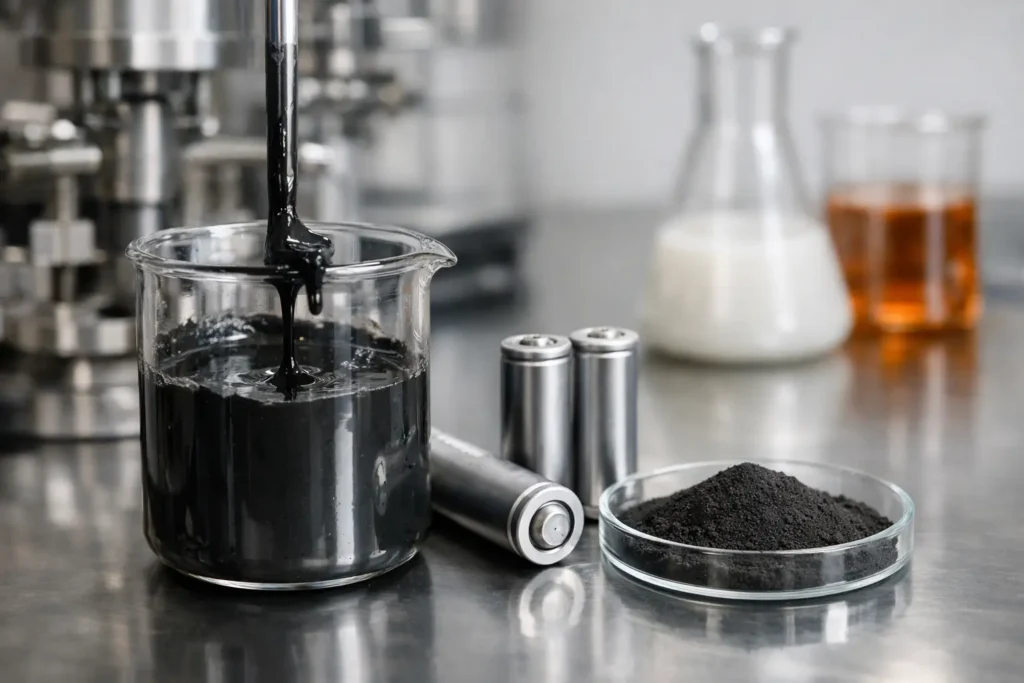
A battery slurry processing example becomes useful when it shows where production risk actually sits – not in the headline recipe, but in how powders are introduced, dispersed, temperature-controlled and deaerated before coating. For battery manufacturers, the slurry step is where upstream material variation turns into either stable downstream performance or expensive inconsistency.
In practical terms, battery slurry production is not just a mixing task. It is a controlled solids-liquid processing operation involving binders, conductive additives, active materials and solvent or water systems that behave differently as shear rises, viscosity builds and air becomes entrained. A process that works in a beaker can fail quickly at plant scale if the mixer type, powder feeding method or vessel geometry are poorly matched.
Consider a typical lithium-ion electrode slurry, whether for anode or cathode manufacture. The exact formulation varies by chemistry, but the process challenge is similar: disperse fine powders uniformly into a liquid phase, develop the correct rheology and deliver a repeatable slurry to coating without agglomerates, sedimentation or excessive air.
A representative process begins with charging the liquid phase into a closed mixing vessel. This may be solvent-based, such as NMP for certain cathode systems, or water-based for selected anode and LFP processes. The binder may be pre-dissolved or introduced in stages depending on its dissolution profile and the target viscosity curve.
Once the liquid phase is conditioned, conductive carbon is often introduced before the bulk active material. This sequence matters. Carbon black and similar conductive additives are low-density, highly dust-prone powders with a strong tendency to float, form fisheyes and trap air. If they are not properly wetted at this stage, downstream dispersion quality is compromised and the finished slurry can show poor electrical uniformity.
After carbon dispersion, the active material is added under controlled shear. At this point, the batch shifts from a relatively low-viscosity liquid into a dense suspension. Torque rises, circulation patterns change and localised over-shear becomes a realistic concern. The objective is not maximum shear for its own sake. It is enough shear, in the right zone of the vessel, for complete wet-out and deagglomeration without damaging sensitive components or overheating the batch.
The final stage usually includes viscosity adjustment, homogenisation and deaeration. Vacuum is often introduced to remove entrained air before transfer to a holding vessel or directly to a coating line buffer. If this step is rushed, microbubbles can survive into coating, where they affect coat weight stability, drying behaviour and final electrode quality.
This battery slurry processing example points to a wider engineering reality: one mixer rarely solves every phase equally well unless it has been configured for the full duty. Early wetting, high-solids dispersion and final deaeration each place different demands on the system.
For many battery slurry applications, a high-viscosity, multi-motion mixer is a strong fit because it combines bulk movement with localised shear. Planetary and dual planetary systems, for example, can handle substantial viscosity increase while maintaining full vessel turnover. When paired with a high-speed disperser and vacuum capability, they offer a more complete platform for battery compounds than a simple top-entry agitator.
That said, there is no universal answer. Lower-viscosity precursor phases may suit high-shear inline recirculation, while very large-volume production may justify a different vessel and transfer architecture. The right choice depends on chemistry, solids loading, batch size, cleanability requirements and whether the process is development-scale, pilot-scale or full manufacturing.
Binder handling sets the baseline for slurry stability. Some binders require time to dissolve fully and can create apparent viscosity that masks incomplete hydration or solvation. If powders are charged too early, undissolved binder can capture fines and create soft agglomerates that are difficult to break later.
Temperature control can help, but only within the chemistry limits. Raising temperature may accelerate dissolution, yet it can also shift viscosity unexpectedly or increase solvent management demands. Process engineers need to treat binder preparation as its own operation rather than a quick pre-mix step.
This stage is often where airborne dust, poor wetting and inconsistent dispersion begin. Carbon materials have low bulk density and high surface area, so powder induction and immediate liquid contact are important. A poorly controlled addition rate can lead to floating rafts, vessel wall build-up and trapped air that follows the batch through the entire process.
The mixer must generate enough surface renewal to pull the powder into the liquid, but the vessel should also be designed to avoid dead zones. This is where integrated disperser tools, vacuum charging and scraper systems can materially improve consistency.
Once the active powder enters, mass flow and energy input become more demanding. Solids loading rises quickly, and if the batch is not turning properly, the process can produce local lumps instead of true dispersion. Operators sometimes respond by increasing speed, but that can worsen heat generation and does not always improve macro-mixing.
A better approach is to engineer around the viscosity profile. Mixer torque, blade path, wall clearance, vessel shape and batch fill level all influence whether the solids are being genuinely incorporated or merely pushed around the vessel.
Air removal is not cosmetic. Entrained air alters density, affects pumping behaviour and introduces coating defects. Under vacuum, the slurry can expand significantly, so vessel freeboard and vacuum control need to be designed accordingly.
Final adjustment is also the point where many plants realise they are correcting for upstream inconsistency. If viscosity requires repeated trimming, the root cause may be powder feeding variation, incomplete dispersion or temperature drift rather than recipe error.
When a slurry shows persistent agglomerates, the issue is often incomplete wet-out rather than insufficient total mixing time. Extending the batch by another hour may not solve poor addition sequence or weak local shear.
If viscosity drifts from batch to batch, solids metering and binder preparation deserve close attention. Small deviations in powder addition order or liquid content can produce large rheology changes once solids loading is high.
If foam or entrained air remains after nominal deaeration, the process may be introducing air faster than vacuum can remove it. High-speed dispersion at the wrong stage, poor powder induction practice or inadequate vessel sealing are all credible causes.
Sedimentation in holding can indicate either inadequate particle size control or a slurry structure that lacks sufficient stability at rest. In some cases, stronger dispersion helps. In others, too much shear has altered the binder network unfavourably. This is exactly why battery slurry process design needs application knowledge rather than generic mixing selection.
A laboratory battery slurry processing example can look convincing because small batches are forgiving. Powders are easier to wet, vessel turnover is faster and operators can intervene manually. At production scale, those advantages disappear.
The scale-up question is not simply whether a larger mixer can reach the same tip speed. It is whether the full process window can be preserved – addition rate, shear exposure, residence time in the high-energy zone, heat removal, vacuum response and discharge behaviour. If one of these shifts too far, the slurry may still look acceptable in the vessel while performing poorly at coating.
This is why industrial buyers should evaluate mixing systems as process equipment, not only as vessels with motors. The specification needs to cover solids handling, temperature control, vacuum integrity, instrumentation, cleanability and automation logic, alongside core mixing performance. For battery compounds, repeatability is usually more valuable than chasing a nominally faster batch cycle that increases variability.
PerMix UK’s approach in this kind of application is to match mixer technology and vessel configuration to the actual material behaviour across the batch, including viscosity rise, deaeration demand and plant integration requirements.
The useful lesson from any battery slurry process is that quality is built in before coating starts. Stable electrode manufacture depends on controlled wet-out, consistent dispersion energy, reliable temperature management and effective air removal. If the mixer is selected only on volume and motor power, process risk tends to surface later as coating defects, scrap or poor cell performance.
For manufacturers reviewing new capacity or upgrading an existing line, the right starting point is not a catalogue category. It is a detailed look at the slurry’s rheology, solids loading, sensitivity to shear, solvent system, batch size and downstream coating requirement. Get that engineering brief right, and equipment selection becomes clearer. Get it wrong, and even a well-built machine may still be the wrong one for the job.
The most useful battery slurry processing example is the one that exposes those decisions early, while they can still be engineered properly.
Stay Connected