Industrial Mixers UK
PerMix Applications

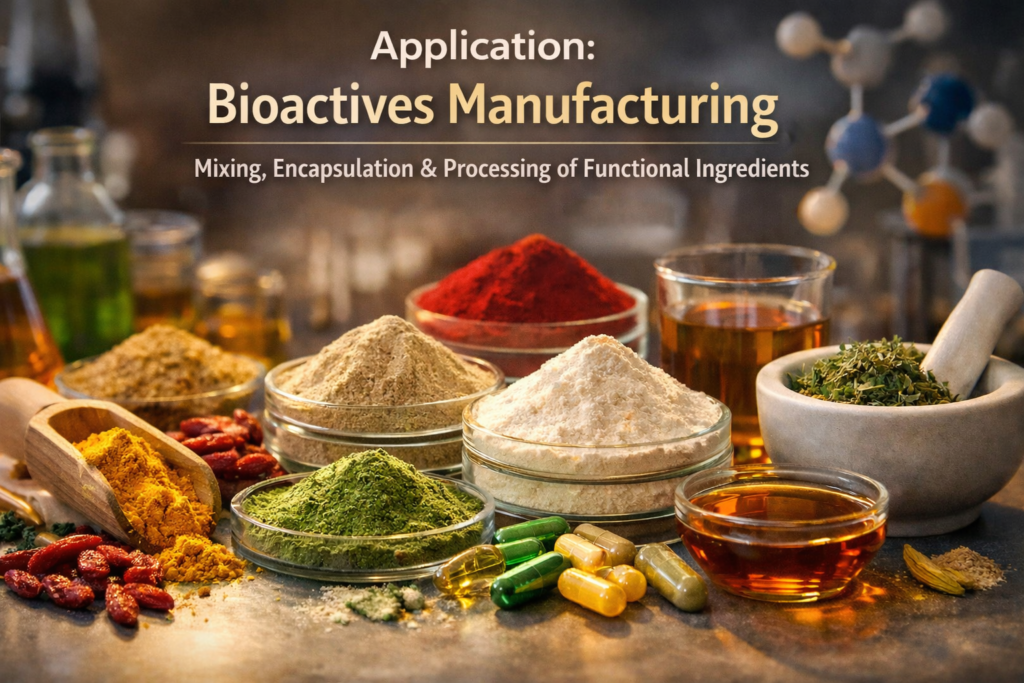
Manufacturing bioactives is becoming one of the fastest-growing sectors in food, nutraceutical, pharmaceutical, cosmetic and functional ingredient manufacturing. From botanical extracts and polyphenols to carotenoids, peptides, proteins, probiotics and plant-based actives, manufacturers across Europe are developing ingredients that deliver measurable biological benefits.
Producing these ingredients at scale, however, is not simple. Bioactive compounds are often extremely sensitive to heat, oxygen, moisture and mechanical stress. Maintaining their potency while processing them in industrial quantities requires carefully engineered manufacturing systems.
This is where advanced mixing, drying and process equipment become critical. PerMix supports bioactives manufacturers by providing mixing technologies designed to protect sensitive ingredients while delivering consistent, scalable production performance.
Bioactive compounds are substances that produce a measurable biological effect in living organisms. In industrial ingredient production, the term typically refers to functional compounds used in food, nutraceutical, pharmaceutical and cosmetic applications.
Common bioactives include:
Polyphenols
Flavonoids
Anthocyanins
Carotenoids
Plant proteins
Collagen peptides
Botanical extracts
Essential oils
Probiotics and prebiotics
Functional nutraceutical compounds
These ingredients are often derived from plants, algae, fermentation processes, dairy proteins or other natural biological sources.
Unlike conventional ingredients, bioactives are valued not simply for flavour or texture, but for their physiological function. This makes their stability and potency during processing critically important.
Across Europe and the UK, consumer demand for functional foods, nutraceutical supplements and natural ingredients continues to rise.
Manufacturers are increasingly producing ingredients designed to support:
Immune health
Digestive health
Metabolic function
Sports nutrition
Cognitive performance
Anti-inflammatory benefits
Antioxidant protection
As this demand increases, producers must develop reliable manufacturing processes capable of preserving the biological functionality of these ingredients while maintaining efficient production.
The challenge lies in scaling delicate laboratory processes into industrial operations without degrading the active compounds.
Bioactive production usually involves a sequence of controlled processing steps. Each stage must be carefully designed to protect the compound’s functionality.
Production typically begins with botanical materials, fermentation biomass, powders, oils or protein concentrates.
At this stage manufacturers often require:
Controlled feeding systems
Screening and sifting
Size reduction
Sanitary transfer systems
Uniform raw material preparation helps ensure consistent downstream processing.
Many bioactives must be extracted from plant or biological matrices.
Common extraction methods include:
Water extraction
Ethanol extraction
Solvent extraction
Enzymatic processing
Cold extraction techniques
Mechanical disruption
The goal is to isolate the desired active compounds while minimising degradation.
Following extraction, the active fraction may be concentrated or standardised to achieve consistent potency.
During this stage materials may be processed into:
Liquid concentrates
Suspensions
Slurries
Emulsions
Paste intermediates
These intermediate forms are then prepared for drying or formulation.
Many bioactives must be blended with carriers or excipients to improve stability, dispersibility and dosing accuracy.
Carriers may include:
Maltodextrin
Proteins
Starches
Fibres
Lipids
Encapsulation matrices
Uniform blending is essential because bioactives are often present at very low inclusion rates.
Powdered bioactives are easier to handle, transport and incorporate into finished products.
Common drying technologies include:
Spray drying
Freeze drying
Vacuum drying
Fluidised bed drying
Drying must be carefully controlled to avoid heat damage or oxidation.
Encapsulation is frequently used to protect sensitive compounds and improve their stability and bioavailability.
Encapsulation helps protect bioactives from:
Heat
Light
Oxygen
Moisture
pH changes
Encapsulation technologies may include spray drying, nano-encapsulation, emulsion systems and polymer or biopolymer coatings.
Producing bioactive ingredients presents several technical challenges that must be addressed through proper process design.
Many bioactive compounds degrade when exposed to elevated temperatures.
Proteins may denature, pigments may degrade, and volatile compounds may evaporate. Low-temperature processing and controlled residence times are therefore critical.
Exposure to oxygen can rapidly degrade many sensitive compounds including oils, antioxidants and botanical extracts.
Sealed processing systems, vacuum mixing and inert gas environments may be required to protect product stability.
Bioactives often require tightly controlled moisture levels.
Excess moisture can cause clumping or microbial growth, while insufficient moisture can reduce dispersion or hydration performance.
Bioactive powders are frequently very fine and cohesive. This can lead to bridging, dust formation and poor discharge behaviour.
Specialised mixing and discharge designs are often required to maintain consistent flow.
Because many bioactives are used at extremely low concentrations, achieving consistent distribution within a batch is essential.
Poor mixing can lead to potency variations that are unacceptable in regulated industries.
Many bioactive ingredients are used in food, nutraceutical or pharmaceutical products.
Equipment must therefore support hygienic operation, easy cleaning and contamination control.
PerMix provides advanced mixing and drying technologies that help manufacturers protect delicate ingredients while maintaining efficient production.
PerMix mixers are designed to achieve highly uniform blending while minimising heat generation and mechanical stress.
This is especially important when processing:
Nutraceutical powders
Botanical ingredients
Functional premixes
Protein blends
Many bioactive formulations require oils, extracts or active solutions to be sprayed into powder blends.
PerMix mixing systems can incorporate spray nozzles, liquid dosing systems and intensifier tools to achieve uniform distribution without clumping.
For oxygen-sensitive or heat-sensitive ingredients, vacuum processing offers significant advantages.
Vacuum mixing and drying can:
Reduce oxidation
Allow lower drying temperatures
Improve solvent removal
Protect product integrity
Jacketed mixing systems allow precise temperature management during processing.
This helps prevent hotspots, maintain product stability and improve process repeatability.
PerMix equipment can be supplied with sanitary finishes and cleanable geometries suitable for food, nutraceutical and pharmaceutical production environments.
In conventional powder blending, poorly designed equipment may simply reduce efficiency.
In bioactives manufacturing, however, improper processing equipment can reduce potency, damage sensitive compounds and compromise product stability.
This makes equipment selection a critical part of successful bioactive ingredient production.
PerMix supports manufacturers across the nutraceutical, food, pharmaceutical and botanical industries with mixing and drying systems engineered for delicate, high-value ingredients.
Whether processing botanical extracts, functional powders, nutraceutical premixes or encapsulated compounds, PerMix equipment helps manufacturers maintain ingredient integrity while achieving reliable industrial production.
Bioactive ingredients may be small molecules, but their impact on product performance is enormous. Protecting those molecules during processing requires precision engineering and carefully designed manufacturing systems.
Stay Connected