Industrial Mixers UK
PerMix News & Updates

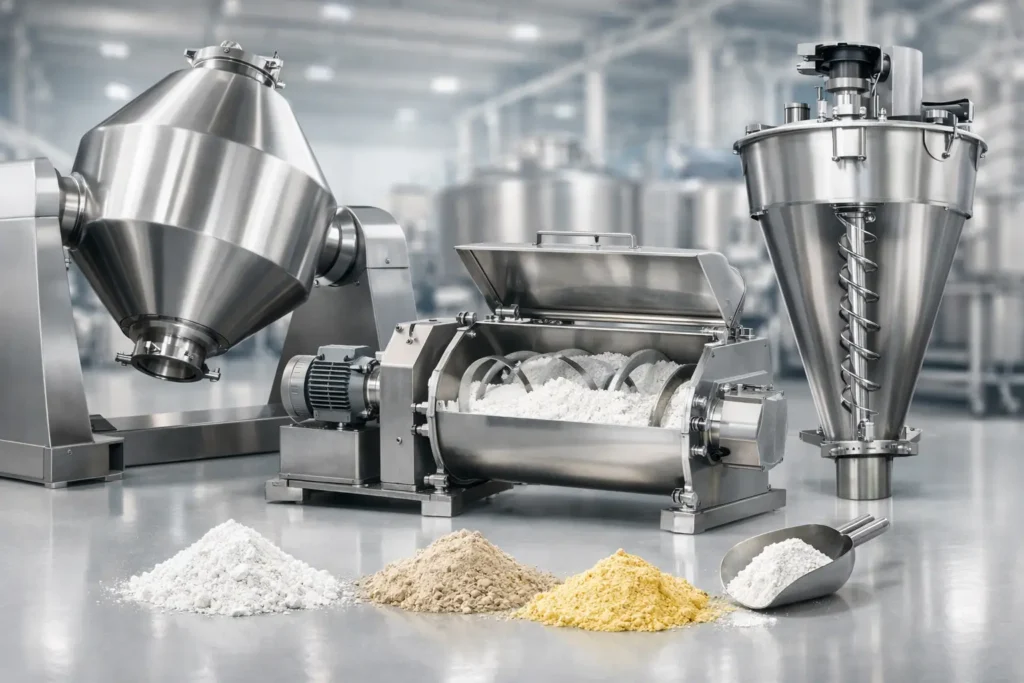
When buyers search for the best powder mixers manufacturers, they are rarely looking for a simple brand list. They are trying to reduce production risk. In powder processing, the wrong supplier choice shows up quickly – poor blend uniformity, extended batch times, segregation, dust control issues, difficult cleaning, and equipment that does not quite fit the process it was bought for.
That is why this is better approached as a specification and supplier-fit exercise than a popularity contest. The strongest manufacturers are not always the largest or the cheapest. They are the ones that can match mixer technology, construction standard, plant integration and compliance requirements to the realities of the product and the site.
At industrial level, powder mixing is not one process. Free-flowing dry blends, cohesive fine powders, abrasive mineral compounds, fragile agglomerates, nutraceutical premixes and battery materials all behave differently. A capable manufacturer should offer more than one mixing principle and be able to explain why a ribbon blender, paddle mixer, ploughshare mixer, conical screw mixer or high shear system is the better fit.
That breadth matters because no single mixer type is best across every application. Ribbon blenders are often well suited to relatively free-flowing powders and large batch production. Paddle and plough mixers can offer faster mixing and better performance with more challenging formulations. Conical screw mixers may suit delicate products, low-shear handling and applications where complete discharge and flexible fill levels matter. High shear systems become relevant when deagglomeration, binder addition or intensive particle interaction is required.
The best suppliers also move beyond the vessel and agitator. They consider charging methods, liquid addition, venting, extraction, discharge valve design, cleanability, wear protection, controls, access, and downstream transfer. Powder mixing performance is shaped by the full system, not just by the impeller geometry.
A serious evaluation starts with process detail. Buyers who provide only batch size and product name usually receive a generic proposal. Better outcomes come when the manufacturer is given information on bulk density, particle size distribution, moisture sensitivity, temperature sensitivity, required homogeneity, cycle time, cleaning regime, and any need for vacuum, heating, cooling or inerting.
A good manufacturer will challenge the brief where necessary. If the stated batch volume creates an unfavourable fill level, they should say so. If the powder blend is segregation-prone, they should address discharge behaviour and post-mix handling. If liquid addition is part of the process, they should discuss spray configuration, chopper requirements and whether the target result is coating, granulation or simple wetting.
This is often where the better manufacturers distinguish themselves. They do not simply quote the machine requested. They test the process logic behind it.
Manufacturers with a broad equipment portfolio can usually give more balanced advice than suppliers tied to one design. A single-technology supplier may still be the right choice if that machine is truly appropriate, but there is a clear advantage in working with a partner that can compare mixing principles from an engineering standpoint.
For industrial buyers, this reduces the risk of forcing every application into the same mechanical format. It also helps where a site handles multiple products with very different behaviours, or where future line expansion is expected.
On paper, many powder mixers look similar. In practice, long-term performance often depends on details such as shaft sealing, weld finish, gearbox sizing, bearing protection, internal clearances, discharge arrangement and access for maintenance. For abrasive or sticky materials, these details become even more important.
The best powder mixers manufacturers typically show strength in fabrication quality and mechanical design discipline. They understand when to specify hardened wear surfaces, mirror-polished internals, ATEX-compliant components, CIP-capable construction or sanitary dead-leg reduction. They also understand that over-engineering and under-engineering both create cost problems.
In food, pharmaceutical, nutraceutical and cosmetics production, cleanability and hygienic design can carry as much weight as mixing speed. In chemicals and advanced materials, operator protection, containment and hazardous-area compliance may dominate the conversation. A supplier that treats these as optional extras rather than design fundamentals is difficult to justify.
Industrial buyers should look for manufacturers that can support the required documentation and construction standard for the sector involved. That may include material certification, surface finish requirements, validation support, ATEX design, pressure or vacuum duty, guard arrangements, and controls integration aligned to site standards.
This is not just a paperwork issue. Compliance affects the actual equipment layout. The right inspection doors, seals, valve designs and automation architecture can improve safety and make routine operation far easier. The wrong choices create workarounds on the factory floor, and those workarounds tend to become permanent.
Some applications can be served very well by a standard powder mixer with a few sensible options. Others cannot. If the process includes heating and cooling, vacuum deaeration, recipe control, loss-in-weight feeding, solvent handling or integration with upstream and downstream equipment, a more engineered approach is often needed.
This is where bespoke capability matters. The best manufacturers are usually able to start with proven standard platforms and adapt them for the process rather than building everything from scratch. That keeps project risk and lead time under control while still addressing the plant’s actual operating conditions.
For example, a powder mixer used in a food premix line may need hygienic construction, rapid cleaning access and precise liquid addition. A unit for specialty chemicals may require wear-resistant internals, explosion protection and controlled thermal management. A system for battery compounds may need strict contamination control, inert atmosphere considerations and repeatable automation. These are very different engineering problems, even if all three are described simply as powder mixing.
The quality of the answers will often tell you more than the brochure. Ask what mixer type they recommend and why. Ask where that recommendation is weak, not just where it is strong. Ask how they would handle scale-up, discharge consistency and cleaning between batches. Ask what options are available for sampling, liquid dosing, temperature control and operator safety.
It is also worth asking how much of the project they can support directly. Some suppliers provide only the machine. Others can support full systems including platforms, controls, feeding, storage vessels and ancillary process equipment. Neither model is automatically better, but the level of responsibility should be clear from the outset.
A manufacturer with real application knowledge should be able to discuss process trade-offs in plain terms. Faster mixing may mean higher shear. More intensive action may increase heat generation. A tighter hygienic design may affect access, cost or maintenance strategy. Mature suppliers do not hide these points.
There is no universal ranking of the best powder mixers manufacturers that works across every industry. The best supplier for a nutraceutical premix is not necessarily the best one for refractory minerals or adhesive powders. What matters is technical fit, engineering credibility and the ability to provide equipment that performs reliably in your operating environment.
For UK and European manufacturers, local technical support, documentation quality and familiarity with regional compliance expectations can also influence the decision. That is especially relevant where projects involve bespoke requirements, FAT expectations, site integration or long-term spare parts support.
PerMix UK sits naturally in this conversation because the requirement is rarely just a mixer. Buyers often need an engineered process solution built around the material, the duty and the production objective. That may involve powder mixing alone, or it may extend into vacuum processing, heating and cooling, hygienic design, vessel supply and automation.
The most useful way to compare suppliers is to look past headline claims and focus on how they respond to the specifics of your process. A credible manufacturer should be able to explain not only what they would supply, but why that configuration will work, where the limits are, and how the design supports consistent production over time.
If a supplier can do that clearly and with evidence, you are usually looking at a serious candidate – regardless of whether they are the biggest name in the market.
Stay Connected