Industrial Mixers UK
PerMix News & Updates

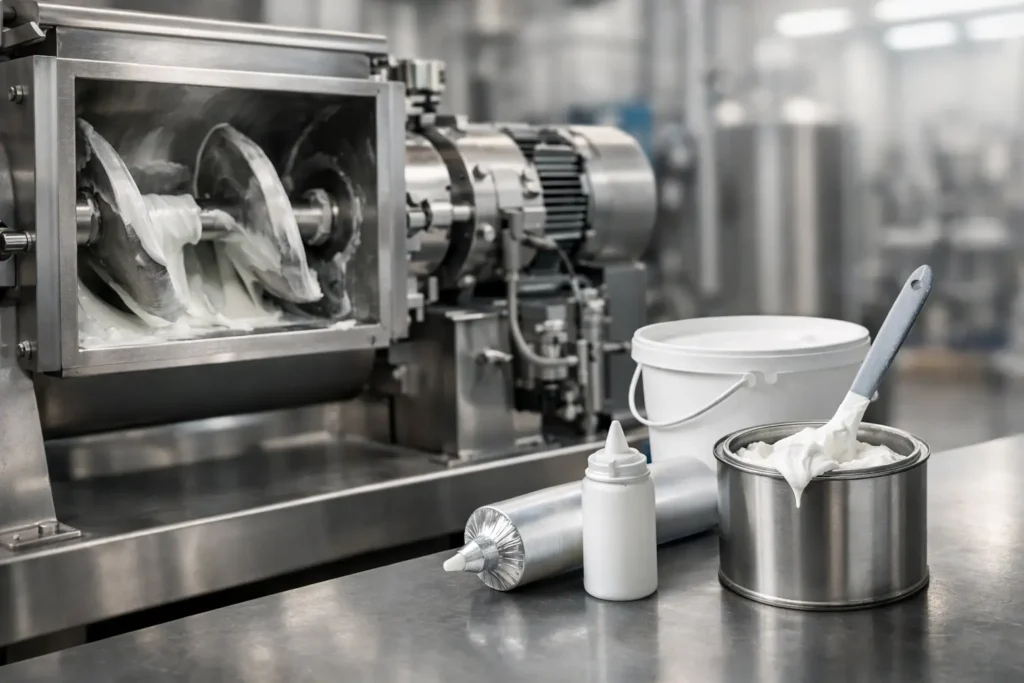
When an adhesive batch starts fighting the mixer, production usually sees it first through longer cycle times, inconsistent dispersion or awkward discharge. A sigma mixer for adhesives is often the right answer when materials move beyond the comfortable limits of conventional agitators and into the high-viscosity, high-shear range where controlled kneading matters.
Adhesive manufacture rarely involves a simple liquid blend. Many formulations combine resins, fillers, tackifiers, plasticisers, pigments and functional additives into a mass that changes character as the batch develops. Viscosity may rise sharply during filler addition. Temperature can influence wetting, flow and final product properties. Air entrainment can affect bond performance and pack appearance. In this process window, a sigma mixer is valued because it handles heavy, resistant materials with a mixing action designed for folding, shearing and smearing across the whole batch.
The defining feature of a sigma mixer is its pair of counter-rotating blades working inside a trough. That geometry creates a strong kneading action, pushing material from the wall to the centre and back again while continuously renewing the product surface. For adhesive systems that behave more like a paste or dough than a free-flowing liquid, this is far more effective than relying on simple circulation.
In practice, that matters for filler incorporation, pigment dispersion and the breakdown of agglomerates. It also helps with heat transfer. Adhesive batches can become locally hot or cold depending on viscosity, shear and vessel design, and poor thermal control can alter reaction rate, solvent loss or final consistency. A properly specified sigma mixer with a jacketed trough and, where required, jacketed blades gives process teams more control over batch conditions.
That does not mean a sigma mixer is automatically the best choice for every adhesive. Lower-viscosity systems may be better served by high-shear mixers, inline rotor-stator equipment or planetary designs depending on formulation and production objectives. The right selection depends on rheology, solids loading, batch size and whether the process demands kneading, dispersion, deaeration, heating or reaction.
For most industrial buyers, the key question is not whether sigma technology works, but whether a given machine configuration matches the process. Adhesive formulations vary too much for a one-size-fits-all approach.
The starting point is the real viscosity profile of the batch, not just the final product data sheet. Some adhesives begin as pumpable liquids and only become heavy after solids addition. Others are highly resistant from the first charge. This affects blade design, motor sizing, gearbox selection and fill level. A mixer that looks adequate on final batch volume alone may struggle once the process reaches peak torque.
Material behaviour under shear also needs attention. Thixotropic, shear-thinning and temperature-sensitive products can respond very differently inside the trough. If the formulation includes elastomeric or stringy components, the kneading action and blade clearance become even more important.
Many adhesive processes depend on accurate thermal management. Resin softening, wax melting, solvent retention and reaction stability can all be influenced by jacket performance. Some batches need rapid heat-up to reduce viscosity for ingredient incorporation, followed by controlled cooling before discharge or packing.
This is where engineering detail matters. Jacket design, heat transfer area, blade configuration and utility conditions all affect performance. If temperature control is treated as an afterthought, cycle times often stretch and batch-to-batch consistency can suffer.
Air is a common problem in adhesive production. It may be introduced during powder charging, high-viscosity kneading or liquid addition. In some products, trapped air affects appearance more than performance. In others, it can compromise density, application behaviour and bond integrity.
A vacuum-capable sigma mixer can improve deaeration significantly, especially in filled or paste-like systems where entrained air is hard to remove by passive settling. Vacuum design should be reviewed alongside shaft seals, condensate handling, vessel strength and any solvent-related safety considerations.
Discharge is often underestimated during equipment selection. A mixer can perform well during the batch but create a bottleneck at the end if the product is difficult to empty. Adhesives may be sticky, cohesive and slow to flow, particularly at lower temperatures.
Depending on the formulation, discharge options may include hydraulic trough tilting, screw extrusion discharge or bottom valve arrangements. The right choice depends on viscosity, downstream packaging or transfer method, cleaning needs and expected cycle time. For frequent product changes, discharge and cleanability deserve just as much scrutiny as mixing performance.
A sigma mixer for adhesives can be configured in several ways, and these choices influence not only output but also maintenance, safety and long-term operating cost.
Blade type is one of the first decisions. Standard sigma blades suit many applications, but dispersion-oriented or multi-purpose blade geometries may be preferable where filler wetting or aggressive working is required. Differential blade speeds can also improve mixing dynamics, especially in highly loaded formulations.
Construction materials should reflect both product compatibility and cleaning regime. Stainless steel is common where corrosion resistance, hygiene or product purity are priorities, while carbon steel may remain suitable for certain chemical duties. Internal finish, seal design and dead-space reduction all contribute to product quality and maintainability.
Automation is another area where requirements vary. Some plants need straightforward local control of speed, temperature and discharge. Others require recipe management, load monitoring, PLC integration and traceability. In regulated or high-value production, these functions support consistency as much as convenience.
For hazardous materials, compliance cannot be bolted on later. If solvents or combustible atmospheres are involved, the mixer and its ancillaries may need appropriate hazardous-area design, grounding, instrumentation and electrical specification. Procurement teams should assess this early, alongside ventilation and plant-wide safety systems.
One of the common mistakes in adhesive manufacturing is assuming that a successful pilot batch will scale directly by geometric enlargement alone. In reality, scale-up affects shear exposure, heat transfer, batch turnover and deaeration efficiency.
A production sigma mixer must be sized around the required output, but also around the mixing intensity and cycle time needed to preserve formulation performance. A batch that disperses well in the lab may need different blade speed, jacket duty or fill level at manufacturing scale. This is why process evaluation should look beyond nominal vessel volume and consider torque, power density and thermal load.
Experienced suppliers will usually ask awkward but necessary questions about ingredient order, maximum viscosity, utility temperatures, cleaning interval and discharge expectations. That level of detail is not sales friction. It is part of getting the specification right.
In many factories, sigma mixers sit at the centre of a wider process rather than operating as isolated units. Upstream handling may include powder charging, resin melting or liquid metering. Downstream equipment might involve holding vessels, transfer pumps, filling machines or extrusion systems.
That plant context matters. The best mixer on paper can still create inefficiency if access is poor, loading is manual where it should be automated, or discharge does not align with the next production stage. For this reason, adhesive manufacturers often benefit from reviewing the complete process path, including operator ergonomics, cleaning access and utility layout.
PerMix UK typically sees better outcomes when mixer selection is treated as a process engineering exercise rather than a catalogue choice. That is especially true for bespoke adhesive systems where thermal control, vacuum integrity and discharge method all influence overall throughput.
Most buyers want the same four outcomes: consistent quality, acceptable batch time, dependable operation and sensible whole-life cost. The challenge is that these goals can pull in different directions.
A more heavily engineered machine may cost more initially but reduce scrap, shorten cycle times and improve uptime. A simplified design may suit a stable, single-product line but become restrictive when formulations change. Vacuum capability, advanced controls and specialist seals add value in some adhesive processes and unnecessary complexity in others.
That is why the best specification is usually the one that fits the actual process window, not the one with the longest feature list. For industrial adhesive manufacture, a sigma mixer earns its place when the process genuinely requires controlled kneading, strong dispersion and reliable handling of heavy materials.
If you are reviewing equipment for a difficult adhesive formulation, it is worth looking closely at what happens between ingredient charging and final discharge. That is where the right mixer stops being a vessel with blades and starts becoming a predictable production asset.
Stay Connected