Industrial Mixers UK
PerMix News & Updates

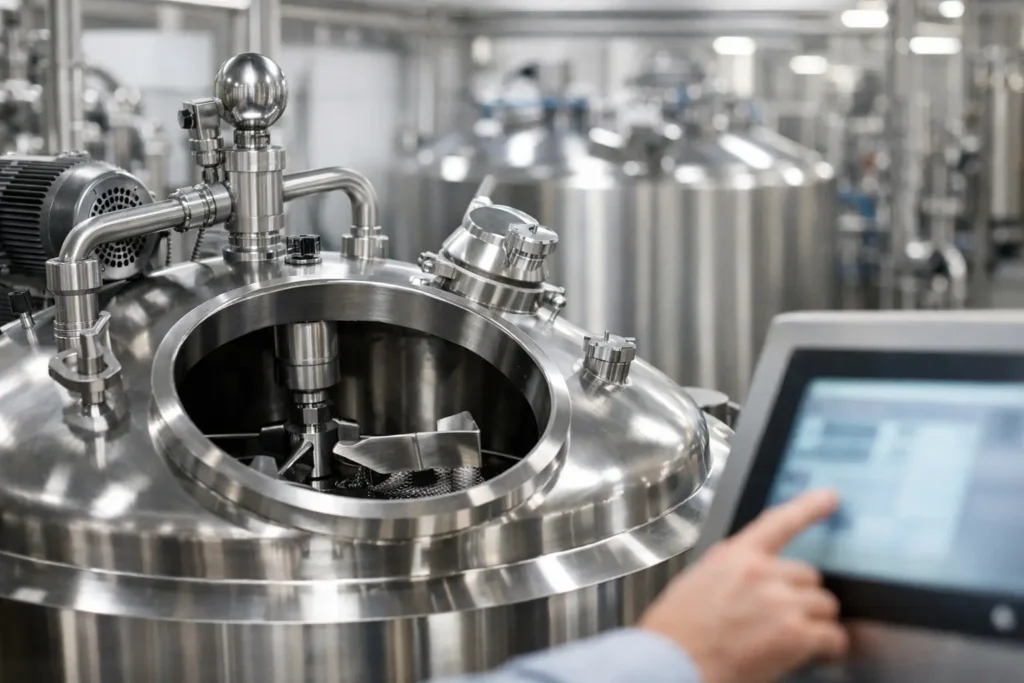
A mixing vessel that is difficult to clean rarely stays a cleaning problem for long. It becomes a production problem, a validation problem and, in regulated sectors, a commercial risk. That is why a CIP hygienic mixing system is not simply a mixer with spray balls added. It is a process asset designed from the outset for repeatable cleaning, controlled product quality and dependable plant availability.
For manufacturers working in food, beverage, pharmaceuticals, nutraceuticals, cosmetics and selected chemical applications, hygienic design has to support more than washdown. It has to suit the product, the process and the cleaning regime without creating dead legs, residue traps or unnecessary downtime. The detail matters because poor cleanability is rarely caused by one major design flaw. More often, it is the accumulation of small compromises around geometry, seals, internals, pipework and surface finish.
At a practical level, the purpose of a CIP hygienic mixing system is straightforward. It must mix the product to specification and then allow the product-contact areas to be cleaned in place without dismantling the equipment for routine cycles. In reality, achieving that consistently depends on the interaction between vessel design, agitator selection, internal fittings, drainage, spray device coverage, cleaning chemistry, temperature and flow regime.
This is where some specifications become too narrow. Buyers sometimes focus on whether the unit is labelled as CIP-ready, but that label alone says very little. A genuinely hygienic system should be designed so that product does not accumulate in areas beyond the reach of cleaning solution, and so that the cleaning cycle itself can be validated against the process risk.
For a low-viscosity beverage base, that may be relatively straightforward. For high-viscosity creams, gel products, nutritional suspensions or sticky flavour systems, the challenge is greater. Product behaviour during processing affects product behaviour during cleaning. If the mixer creates build-up above the liquid line, shadowing beneath baffles or retention around shaft seals, the CIP regime has to work much harder.
A well-designed vessel body provides the foundation for cleanability. Internal geometry should promote full drainability, smooth flow paths and minimal hold-up. Flat spots, poorly blended welds and abrupt transitions all increase the risk of residue retention. Surface finish also plays a direct role, particularly where product is prone to adhesion or where validation standards are strict.
The same applies to internals. Agitators, high shear heads, scrapers, stators, baffles and probes all influence both mixing performance and cleanability. In some applications, the most aggressive mixing technology is not automatically the best overall choice if it introduces hard-to-clean areas or increases maintenance frequency. It depends on the formulation and the production target.
For example, a batch requiring powder incorporation and rapid homogenisation may benefit from a rotor-stator arrangement. But if the product range includes allergen changeovers, the internal design has to allow complete flushing of product residues from the shear assembly. Likewise, anchor agitators used for viscous products can be highly effective, but scraper blade material, mounting detail and shaft arrangement should be considered in relation to cleaning access and wear.
Seals and connections are common weak points in hygienic equipment. Mechanical seals, valve seats, manways, instrument ports and outlet assemblies all need close attention. A system can have an excellent vessel body and still underperform in hygiene terms if the peripheral details are not properly engineered.
This is particularly relevant in high-care and high-value production. If the process involves sterile ingredients, sensitive actives or contamination-sensitive formulations, the specification of seals, elastomers and sanitary fittings is just as important as agitator power or vessel volume. The aim is not only to contain the product during operation, but also to ensure those interfaces can be effectively cleaned and, where required, sterilised.
No single cleaning arrangement suits every mixer. Spray balls may be acceptable in some duties, but rotary spray heads or more targeted cleaning devices are often better suited where internal coverage is complex or residues are tenacious. The right choice depends on vessel geometry, product characteristics and cleaning expectations.
A useful way to assess this is to think in terms of the whole duty cycle. What is being mixed, at what viscosity, at what temperature, and how frequently are changeovers required? A sugar syrup tank and a vacuum emulsifying mixer for cosmetic cream present very different CIP demands. One may prioritise rapid turnaround. The Other may prioritise complete residue removal from high-shear zones and vessel lid internals.
Cleaning chemistry and process temperature also need to be considered alongside the mechanical design. Some products release easily with warm water and alkaline detergent. Others require more aggressive or staged cleaning cycles. In those cases, material compatibility across the vessel, seals, gaskets and pipework becomes a key procurement issue rather than an afterthought.
In regulated sectors, cleanability cannot rely on operator judgement alone. The cleaning cycle needs to be repeatable, measurable and, where necessary, documented. That usually means integrating the CIP hygienic mixing system with controlled sequencing, defined flow parameters and appropriate instrumentation.
Automation has a clear role here. Timed cycles, controlled dosing of cleaning media, monitored temperature and conductivity, and recipe-based cleaning programmes reduce variability between batches and shifts. They also support production planning because cleaning becomes a defined process step rather than a loosely managed activity.
There is a trade-off, of course. Higher automation increases capital cost and may require more integration work with plant utilities and controls architecture. But in many factories that cost is justified quickly through reduced downtime, lower rework risk and stronger audit readiness.
The most common mistake is treating hygiene as an add-on instead of a design principle. A buyer may request a mixer with stainless construction, polished internals and CIP capability, but those features do not automatically guarantee hygienic performance. If the agitator arrangement, nozzle layout or discharge design is not suited to the product, the cleaning cycle may remain inefficient.
Another problem is underestimating viscosity. As viscosity rises, the gap between acceptable cleaning and difficult cleaning widens quickly. Products that cling to vessel walls, lid undersides and shaft components can extend cycle times and water consumption significantly. In those cases, design features such as wall scrapers, heated vessels, conical bottoms and optimised outlet geometry should be assessed together rather than separately.
Factory constraints also influence the right answer. Ceiling height, access for maintenance, utility availability, hazardous area requirements and upstream or downstream equipment interfaces all affect the final system design. A good specification therefore starts with the process and the site, not just the nominal vessel size.
For technical buyers and engineers, the most useful question is not whether a mixer is hygienic in general terms. It is whether the proposed system is hygienic for your product family, your cleaning standard and your production schedule.
That means reviewing the intended product range, including worst-case formulations. It means understanding whether the plant needs simple rinse-through cleaning or validated multistage CIP with defined recovery targets. It also means checking how the mixer integrates with associated tanks, transfer lines, dosing systems and control platforms.
In supplier discussions, practical detail is more revealing than broad claims. Ask where product may collect. Ask how the shaft seals are cleaned. Ask whether the vessel is fully drainable in its installed position. Ask how spray coverage has been assessed. Ask what changes if the product viscosity doubles or if you introduce a powder that tends to raft on the surface. These are the questions that separate a standard catalogue unit from an engineered process solution.
For many manufacturers, the right answer lies in a custom-configured system rather than a purely standard machine. That is especially true where heating and cooling, vacuum operation, powder induction, deaeration or ATEX-related requirements are part of the process. PerMix UK typically sees best results where hygienic design is considered together with mixing performance, not after the equipment concept has already been fixed.
A well-specified CIP hygienic mixing system supports far more than cleanliness. It can shorten changeovers, reduce labour input, limit water and chemical use, improve batch consistency and support compliance with customer and regulatory expectations. Those gains often matter more over the equipment lifecycle than a small saving on initial purchase cost.
It is also worth recognising that over-specification can be just as unhelpful as under-specification. Not every application needs the highest polish level, the most advanced spray device or the most complex automation package. The objective is to match the equipment to the actual risk profile and operating model of the plant.
The strongest projects are usually those where process engineering, hygiene requirements and production realities are aligned early. When that happens, the mixer is easier to clean, easier to validate and easier to live with day after day. That is the standard worth aiming for when hygienic processing is central to product quality and plant performance.
Stay Connected