Industrial Mixers UK
PerMix News & Updates

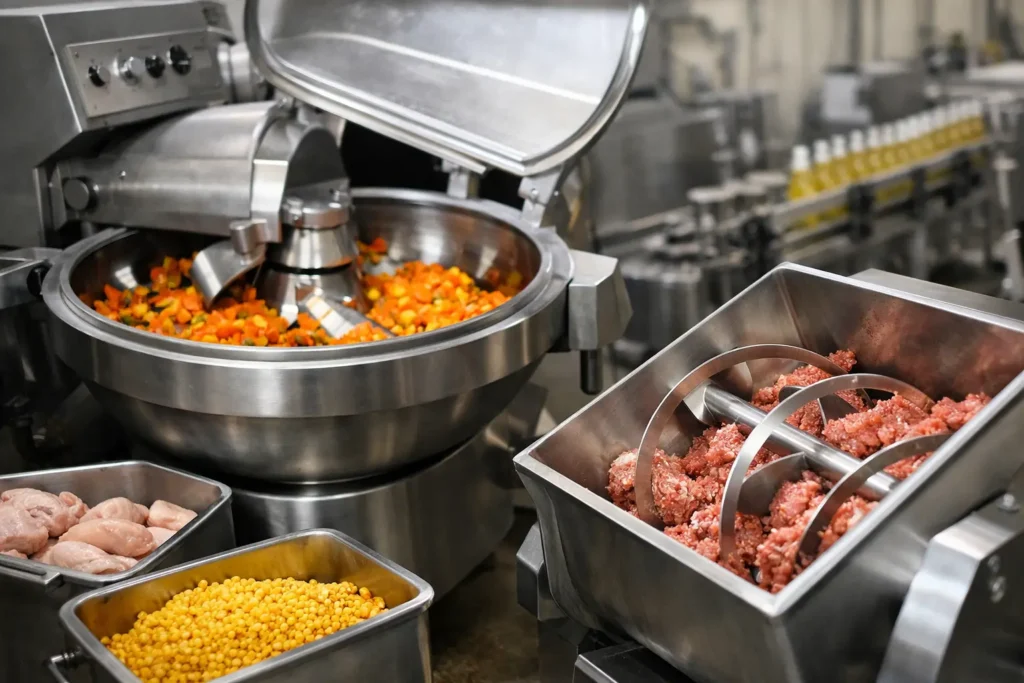
A mixer that performs well with sugar syrup can fail completely on a high-viscosity paste. A vessel suited to gentle blending may be the wrong choice for heating, vacuum deaeration or abrasive inclusions. That is why food processing mixers should never be treated as interchangeable plant items. In food manufacturing, the mixer sits at the centre of product quality, batch repeatability, hygiene control and production efficiency.
For process engineers and technical buyers, the real question is not simply which mixer to buy. It is which mixing technology matches the product, the process conditions and the site requirements with the least compromise.
Food products span a very wide range of behaviours. Powders can be free-flowing, cohesive or segregation-prone. Liquids may be low-viscosity and easy to circulate, or shear-sensitive and prone to foaming. Pastes and semi-solids can require high torque, close-clearance mixing and controlled heat transfer. Even within one factory, a sauce line, a dry seasoning line and a confectionery batch process may all need entirely different mixer designs.
This is where application-led equipment selection matters. The right machine is determined by material state, viscosity profile, particle size, solids loading, temperature sensitivity, required batch time and cleaning method. A mixer that looks adequate on paper can create long cycle times, dead zones, inconsistent hydration or poor ingredient dispersion once it is installed.
In practical terms, specifying the correct equipment at the outset reduces process risk. It also helps avoid costly workarounds such as manual ingredient intervention, overmixing, excessive energy input or repeated quality deviations.
The starting point is always the product itself. Different food processing mixers are designed around different flow patterns, shear levels and discharge characteristics.
For dry food products such as spice blends, bakery premixes, beverage powders and nutritional formulations, the priority is usually uniformity without damaging fragile ingredients. Ribbon blenders, paddle mixers and other horizontal powder mixer designs are often selected where rapid, consistent blending is required across powders with similar bulk properties.
That said, powder behaviour rarely stays simple. Fine powders may bridge or agglomerate. Minor ingredients may need precise dispersion at very low inclusion rates. Oil addition can change the mixing regime completely. If the process includes liquid spray, choppers or intensifiers may be required to break lumps and maintain homogeneity.
Liquid food systems such as syrups, dairy blends, brines and beverage bases often require controlled agitation rather than aggressive shear. In these cases, impeller type, baffle arrangement and tank geometry matter as much as motor power. The aim may be dissolution, suspension, heat transfer or blending of miscible phases.
For low to medium viscosity products, the wrong agitator can create vortexing, air entrainment or poor top-to-bottom circulation. Where ingredients are shear-sensitive, preserving texture can be more important than reducing mix time by a few minutes.
High-viscosity foods such as fillings, spreads, confectionery masses, sauces and emulsified products place much greater mechanical demand on the system. Anchor mixers, planetary mixers and double planetary designs are often better suited where the product will not flow freely under standard agitation.
These applications frequently involve more than mixing alone. Heating, cooling, vacuum processing and wall scraping may all be essential to achieve the required finish, moisture control or deaeration. In that environment, the vessel and the mixer must be designed as one process system.
A mixer should be judged on what happens during the full production cycle, not only during the blending stage. Many food processes involve multiple steps inside one vessel, and each step changes the engineering requirement.
If the batch must be heated, the thermal performance of the vessel jacket, agitation pattern and scraper arrangement becomes critical. If cooling is required, the system must maintain movement at rising viscosity to prevent localised build-up on heat transfer surfaces. If vacuum is applied, shaft sealing, vessel integrity and foam behaviour all come into play.
Throughput also deserves close scrutiny. A machine that delivers good quality at pilot scale may not maintain the same result at production volume without changes to geometry, power input or discharge design. Likewise, an acceptable batch time on paper may not hold up once ingredient charging, CIP preparation and product discharge are included.
In food manufacturing, hygienic design is not an optional extra. It directly affects contamination risk, cleaning validation, downtime and audit readiness. Food processing mixers must be designed for the site’s hygiene regime and the product category being processed.
Material of construction is the baseline. Stainless steel grades, internal surface finish and weld quality should align with the food contact requirements and the aggressiveness of the cleaning chemicals. Beyond that, details such as crevice-free design, drainability, seal arrangement and access for inspection often determine whether a system performs well in daily production.
There is also a trade-off to manage. A highly configurable process vessel with multiple ports, instrumentation points and auxiliary systems may offer excellent process control, but each additional feature has implications for cleaning complexity. The best specification is usually the one that balances process capability with realistic hygiene management on the factory floor.
Where allergen control, frequent product changeover or strict hygienic segregation are involved, cleanability can carry as much weight as raw mixing performance.
A mixer rarely operates in isolation. It must fit with upstream material handling, dosing systems, transfer pumps, holding tanks and downstream filling or forming equipment. This is where many specification exercises become too narrow.
Ingredient charging needs to be considered carefully. Manual sack tipping, vacuum conveying, big bag discharge and liquid metering all place different demands on mixer layout and vessel access. Product discharge is equally important. A mixer can achieve an excellent batch result, but if it leaves excessive heel or discharges too slowly, line efficiency suffers.
Control philosophy also matters. Some plants need stand-alone operation. Others require full PLC integration, recipe management, load cell batching, temperature control and data capture. For regulated or high-value products, automation can improve repeatability and operator consistency significantly, but it should be proportionate to the process need.
There is no universal rule here. Standard mixer platforms are often the right answer where the product is well understood and the process is straightforward. They can offer shorter lead times, proven performance and good commercial value.
Bespoke engineering becomes more relevant when the application includes unusual rheology, multi-stage processing, site constraints, hazardous-area requirements or demanding heating and cooling duties. In those cases, adapting the drive arrangement, vessel geometry, scraper design, discharge configuration or control package can make the difference between a workable line and an optimised one.
For many manufacturers, the most effective route sits somewhere in the middle – a proven mixer type configured with application-specific options. That approach tends to reduce technical risk while still addressing the realities of the process.
The most useful supplier conversations start with process facts rather than generic capacity requests. Batch size is important, but it is only one variable. Buyers should be clear on the product’s behaviour across the full cycle, including viscosity changes with temperature, solids content, shear sensitivity and the required final texture.
It also helps to define what success looks like in measurable terms. That may mean blend uniformity, maximum batch time, acceptable temperature deviation, target vacuum level, discharge efficiency or cleaning turnaround. Without those criteria, comparing equipment options becomes too subjective.
This is where an engineering-led supplier adds value. Rather than simply quoting a machine category, they should be able to challenge assumptions, identify process risks and recommend a mixer configuration that supports long-term production performance. For industrial food manufacturers, that technical fit will usually matter more than headline motor size or vessel volume.
PerMix UK operates in that space, where mixer selection is tied to the actual application rather than to a standard catalogue description.
Poor mixer selection is expensive in ways that are not always obvious at purchase stage. The direct cost of the machine is only part of the picture. Lost yield, slow cycles, excess labour, inconsistent product quality, cleaning inefficiency and unplanned maintenance all affect the total cost of ownership.
A well-specified system improves more than throughput. It supports process control, reduces operator intervention and helps maintain consistent product standards batch after batch. In sectors where margins, audits and customer specifications are all under pressure, that consistency has real commercial value.
The best food processing mixers are not defined by complexity for its own sake. They are defined by how accurately they match the material, the process and the production environment. That is the standard worth aiming for when the mixer is expected to do more than simply turn a batch.
Stay Connected