Industrial Mixers UK
PerMix News & Updates

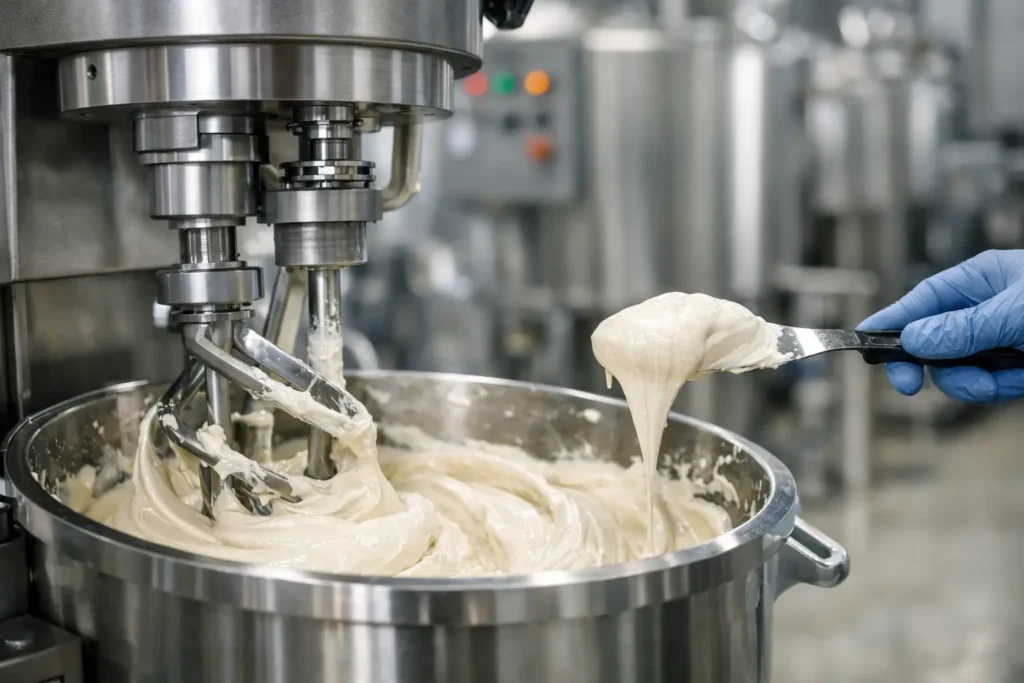
When a paste stops flowing and starts resisting every movement in the vessel, mixer selection becomes a process decision rather than a purchasing exercise. A planetary mixer for viscous paste is typically specified when conventional agitators cannot deliver enough bulk movement, wall contact or consistency across the batch. In sectors such as adhesives, sealants, cosmetics, battery materials and specialist chemicals, that difference has a direct effect on throughput, product quality and downstream filling.
Highly viscous materials do not behave like free-flowing liquids. They form stagnant zones, trap air, generate localised heat and can climb the mixing tool instead of recirculating properly. A planetary mixing action addresses this by combining tool rotation with orbital movement around the vessel. That geometry continuously sweeps fresh material into the working zone and improves turnover from the vessel wall to the centre.
The result is not simply stronger mixing. It is more controlled mixing for products that need uniform dispersion, repeatable texture and reliable deaeration. For many paste applications, especially where viscosity rises during the batch, this is the difference between a stable process and one that becomes slower and less predictable as production scales.
In practical terms, planetary systems are often selected for materials such as silicone sealants, epoxy compounds, carbon pastes, solder pastes, putties, creams and heavy suspensions. These products may require not only blending, but also powder incorporation, wetting of fine solids, removal of entrained air and heat transfer through the vessel wall.
Not every thick product needs the same machine configuration. Some pastes are shear-sensitive and need careful folding with limited temperature rise. Others need aggressive dispersion to break down agglomerates or distribute pigments, fillers and functional powders. A buyer assessing a planetary mixer should therefore start with the process duty, not just the viscosity number.
Yield stress matters. So does thixotropy, solids loading, particle size, density difference between phases and whether the batch changes character during production. A compound that starts as a low-viscosity binder and ends as a dense filled paste places very different demands on the mixer over time. The machine has to cope with the most demanding part of the cycle, not only the starting point.
Batch size is equally important. A small laboratory unit can often produce acceptable results because operators allow extra mixing time or intervene manually. At production scale, those workarounds disappear. The mixer must deliver repeatable circulation and power input under full load, with consistent clearances and predictable heat removal.
A planetary mixer for viscous paste is only as effective as the detail of its configuration. The mixing tools are central. Single and double planetary arrangements are common, with tool geometry selected to match the rheology of the product. Blade profile, width and wall clearance all influence turnover, shear and discharge behaviour.
Many paste applications benefit from the addition of a high-speed disperser within the same vessel. This hybrid arrangement allows the system to combine macro-mixing with localised high shear. It is particularly useful where powders need to be incorporated into a resin or liquid phase without prolonged cycle times. The trade-off is that more shear can mean more heat generation, so thermal control becomes more critical.
The vessel design also carries more weight than many buyers initially expect. Jacketed vessels support heating or cooling, which may be necessary to control viscosity, improve solubility or protect heat-sensitive ingredients. Accurate wall scraping is equally valuable because viscous material tends to adhere to the vessel surface, reducing heat transfer and creating unmixed regions if it is not continuously removed.
Drive sizing should be assessed with care. Underpowered machines may appear acceptable during trials with partial loads or lower-viscosity formulations, then struggle when solids content increases or temperatures fall. Oversizing, however, is not automatically better. It can add cost, increase mechanical stress and reduce efficiency if the process requires controlled, moderate shear rather than brute force.
For many paste products, vacuum is not an optional extra. It is part of the process. Entrained air can affect density, appearance, filling accuracy, dielectric properties, bond strength and shelf life. In products such as sealants, electronic materials and cosmetic creams, even small volumes of trapped air can create quality issues that are costly to correct downstream.
A vacuum-capable planetary mixer helps remove air while mixing continues, which is generally more effective than attempting to deaerate after the material has been transferred. It also improves powder wetting in some formulations by reducing air pockets around fine particles. That said, vacuum performance depends on vessel integrity, seal design, condensate management and the material’s tendency to foam or release volatiles.
Where solvent handling or hazardous ingredients are involved, the specification becomes more exacting. ATEX considerations, appropriate sealing arrangements and compatible materials of construction need to be addressed at the design stage rather than added later.
In food, nutraceutical, pharmaceutical and cosmetic production, hygienic design is not just about polished surfaces. It affects cleanability, inspection access, changeover time and the risk of cross-contamination. A planetary mixer used in these sectors may require stainless steel contact parts, validated surface finishes, sanitary seals and a vessel arrangement that supports efficient cleaning.
The required level of hygiene depends on the application. Some plants need straightforward washdown and good access for manual cleaning. Others require full CIP integration, documented material traceability and design features that align with internal validation protocols. Buyers should be realistic about what their own site standards demand and specify accordingly.
For chemical and adhesive applications, hygiene may be less important than resistance to abrasion, solvents or corrosive components. In those cases, the right materials of construction, shaft sealing and gasket compatibility can have a greater impact on lifecycle cost than cosmetic finish.
One of the most common pitfalls in viscous paste processing is assuming that a successful bench trial guarantees a smooth production launch. Scale-up in planetary mixing is more complex than simply increasing vessel volume. Heat transfer changes, tool tip speed changes, power per unit volume changes and deaeration behaviour often changes as well.
This is why process data from trials should be reviewed in detail. Mixing time alone is not enough. Useful scale-up information includes temperature profile, batch viscosity at each stage, powder addition rate, vacuum level, torque response and final product quality against specification. Without that data, production equipment may be sized on assumptions rather than evidence.
An engineering-led supplier should be able to discuss not only the mixer, but also the wider system around it. This may include vessel exchange arrangements, discharge methods, lifting systems, automated dosing, load cells and recipe control. In a high-throughput plant, these details often determine whether the mixer becomes a productive asset or a bottleneck.
The strongest specifications are built around the material and the process objective. Buyers should look beyond nominal capacity and motor power and ask how the mixer performs at the highest expected viscosity, how it handles heat, how it removes air and how reliably it discharges the finished paste.
Attention should also be paid to maintenance access and mechanical durability. High-viscosity duty places considerable load on gearboxes, bearings and seals. A machine that performs well in principle but is difficult to service can become expensive in practice. For regulated sectors, documentation, certification and finish quality should be reviewed as part of the technical assessment, not as a late-stage procurement check.
Where the process is still developing, flexibility may justify a more configurable design. PerMix UK, for example, supports industrial users that need equipment tailored around product rheology, thermal duty, compliance requirements and plant layout rather than a fixed catalogue specification. That approach tends to be valuable where formulations vary or future capacity changes are likely.
A planetary mixer is highly effective for many paste duties, but it is not universal. If the product is low-viscosity for most of the cycle, a simpler agitator may be more economical. If the process demands extremely high shear dispersion above all else, a dedicated rotor-stator or media-based system may play the lead role. Continuous production requirements can also point towards a different technology altogether.
The right question is not whether planetary mixing is superior in general. It is whether it matches the rheology, thermal sensitivity, batch size and production target of the product in front of you. In many industrial paste applications, it does. Where it does not, that should be identified early, before the specification hardens around the wrong machine.
For manufacturers handling difficult, air-sensitive or heavily filled products, choosing the right mixer usually comes down to one principle: specify for the real process, not the idealised one. The batches that test your equipment on the worst day in production are the ones your mixer needs to handle with confidence.
Stay Connected