Industrial Mixers UK
PerMix News & Updates

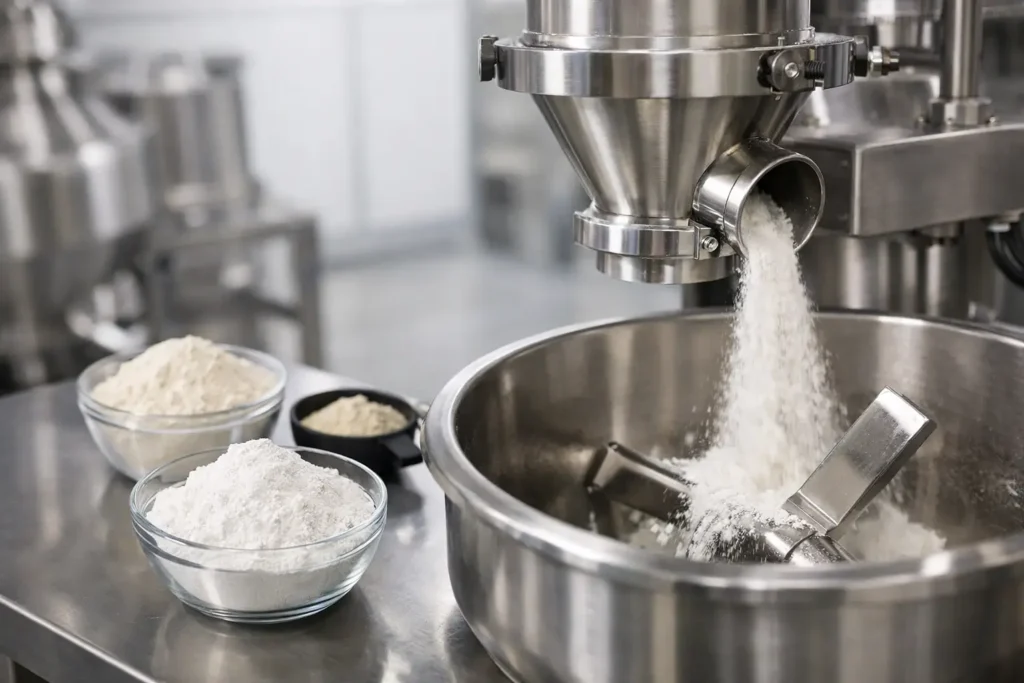
A powder mixer that performs well in one plant can be the wrong choice two doors down. The reason is simple: powders do not behave consistently across applications. Bulk density, particle size distribution, moisture content, friability, electrostatic behaviour and ingredient ratios all change the way a product blends, segregates and discharges. For manufacturers working to tight quality tolerances, mixer selection is a process decision, not just an equipment purchase.
In production environments, the cost of getting that decision wrong is rarely limited to poor blend uniformity. It can show up as long batch times, excessive cleaning labour, dust control issues, damaged particles, heat build-up, inconsistent downstream filling and repeated quality investigations. A well-specified powder mixer should support the full process – from charging and blending to discharge, cleaning and integration with upstream and downstream equipment.
At specification stage, the question is not simply how to mix powder. The more useful question is what the mixer must achieve under real operating conditions. Some processes need gentle blending to preserve particle integrity and avoid segregation. Others need high-intensity action to break agglomerates, distribute minor ingredients or incorporate small liquid additions. In regulated sectors, the requirement may extend beyond mixing performance to include hygienic design, material traceability, validation support and repeatable cleanability.
This is why the best powder mixer is application-specific. A free-flowing food premix, a cohesive pharmaceutical powder, a metal additive feedstock and a speciality chemical compound may all be powders, but they place very different demands on the machine. Batch volume, required homogeneity, allowable mixing time and sensitivity to shear all matter. So do room constraints, hazardous-area classification and the level of automation expected by the plant.
Different mixer technologies solve different process problems. The right choice depends on how the material moves, how quickly the blend must be completed and how much mechanical energy the product can tolerate.
Horizontal ribbon blenders are widely used for dry powder blending where reliable batch consistency and good throughput are priorities. They create a balanced convective mixing pattern and can handle a broad range of bulk densities and formulations. For many food, chemical and industrial powders, they offer a practical combination of capacity, accessibility and cost-effectiveness.
Paddle mixers tend to be gentler and can be better suited where particle degradation is a concern or where the formulation includes fragile solids. Depending on configuration, they can also handle powder-liquid mixing duties effectively, particularly where controlled addition is needed without creating wet lumps.
Where faster blending and deagglomeration are required, ploughshare-style mixers provide more energetic mechanical action. They are often specified for difficult powders, low-dose ingredient distribution and applications that benefit from choppers or side-mounted high-speed tools. That added intensity improves dispersion, but it also introduces trade-offs. Product heating, wear, and cleaning complexity may increase depending on the formulation and duty cycle.
Conical screw mixers and other vertical designs are often selected for materials that are shear-sensitive, segregate easily or require thorough blending at relatively low energy input. They can be particularly useful for large batches where footprint, product protection or complete discharge are important. In some cases, they also support vacuum operation, heating or drying as part of a wider process requirement.
For highly friable products or applications where ultra-gentle movement is preferred, tumble blending can be the right approach. These machines are common in sectors where particle shape and integrity are critical. The limitation is that gentle motion does not suit every formulation, especially if there are strong differences in particle size, density or electrostatic behaviour.
Industrial buyers are often presented with standard performance claims, but powder behaviour does not follow catalogue language. A mixer described as suitable for powders may still struggle with a formulation that bridges, smears, fluidises unpredictably or absorbs moisture from the atmosphere.
Material testing is therefore central to specification. The way a powder flows into the vessel, circulates during mixing and leaves the discharge valve can reveal more than nominal machine type alone. A cohesive nutraceutical blend, for example, may need stronger mechanical action than expected, while an instant beverage powder may require a gentler approach to protect particle structure and maintain reconstitution performance.
Minor ingredients deserve particular attention. If the process involves adding low-percentage actives, colours, flavours or functional additives, the powder mixer must distribute them uniformly across the batch without over-processing the bulk material. This is where machine geometry, fill level and mixing intensity become critical.
Mixers operate best within a defined working range. Too little product and the mixing pattern may be inefficient. Too much and material movement becomes restricted, increasing cycle time and reducing blend quality. Buyers should assess not only nominal capacity but realistic minimum and maximum working volumes against production scheduling.
A shorter blend time is attractive, but not if it creates heat, fines or segregation during discharge. Throughput should be measured across the full cycle, including loading, mixing, sampling, discharge and cleaning. In many plants, changeover time has as much impact on output as the core mixing phase.
For food, pharmaceutical and cosmetic production, hygienic design is not optional. Surface finish, weld quality, access for inspection, dead-leg reduction and valve design all influence cleaning effectiveness. The right powder mixer for a hygienic process is one that can be cleaned consistently and verified with minimal downtime.
Fine powders create operational and safety challenges. Dust generation affects operator exposure, housekeeping and product yield. In some sectors, it also introduces explosion risk. A proper specification should consider sealed charging, extraction interfaces, inerting, pressure resistance and ATEX requirements where applicable.
The mixer does not work in isolation. It must fit with feeding systems, storage, sieving, conveying, dosing, sampling and packaging. Controls are equally important. Recipe management, timed sequences, interlocks and load-cell integration all improve repeatability and reduce operator dependence.
There are many applications where a standard machine will do the job well. There are just as many where it will do the job badly, even if it appears close on paper. Powders with unusual flow characteristics, strict containment needs, thermal sensitivity or demanding cleanability standards often require a more tailored solution.
That may involve modified agitator design, special seals, vacuum capability, jacketed vessels, polished internal surfaces, explosion protection, automated liquid addition or bespoke discharge arrangements. In a constrained plant, overall dimensions and service access can be as important as mixing performance. Engineering a powder mixer around the process rather than asking the process to adapt to the machine is often the sounder commercial decision.
This is where an application-led supplier adds value. PerMix UK, for example, works across multiple mixing technologies, which matters because it allows the equipment recommendation to follow process requirements rather than forcing every application towards a single platform.
A good supplier discussion usually starts with the product, not the motor size. What is the true bulk density range? Does the powder cake in storage? Is segregation happening after mixing rather than during it? Will there be liquid addition, heating, cooling or vacuum? How often will the product change, and how demanding is the clean-down?
It is also worth clarifying what success looks like. Some plants need a narrow coefficient of variation for active ingredients. Others are more concerned with cycle time, discharge rate or containment. The right answer depends on the process priorities, and those priorities should shape the machine design.
For procurement teams, lifecycle issues should be part of the same conversation. Spare parts availability, wear resistance, maintainability, documentation and compliance support all affect the true cost of ownership. A lower initial price can quickly lose its appeal if the mixer is difficult to clean, awkward to maintain or inconsistent at scale.
When specified properly, a powder mixer improves more than blend quality. It supports stable downstream performance, reduces operator intervention, shortens changeovers and gives production teams a more repeatable manufacturing window. That reliability becomes especially valuable in regulated industries and high-value formulations, where inconsistency is expensive.
The better approach is to treat mixer selection as part of process engineering from the outset. Look closely at the material, define the production objective clearly and assess the practical realities of the plant. A powder mixer should not merely turn powder over in a vessel. It should fit the product, the factory and the standard of performance the operation is expected to deliver.
Stay Connected