Industrial Mixers UK
PerMix News & Updates

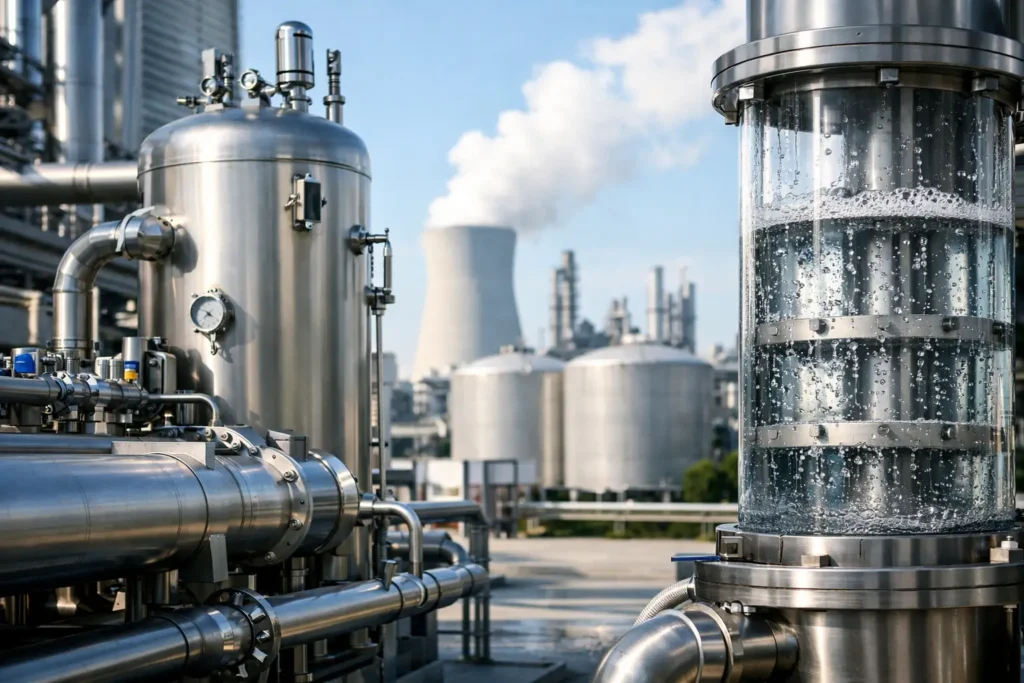
Air in the product is rarely a minor issue. In many production environments, entrained or dissolved petrol affects fill accuracy, surface finish, density, oxidation, pumpability and downstream stability long before it becomes visible in the vessel. That is why a practical guide to industrial deaeration methods starts with process impact rather than theory. The right approach depends on what the petrol is doing in your formulation, when it is being introduced and how sensitive the product is to shear, heat and pressure.
Deaeration is used across food, pharmaceuticals, cosmetics, chemicals, adhesives and high-viscosity compounds for one reason – process consistency. In some applications the target is removal of visible foam. In others, it is the reduction of microbubbles that compromise packaging, coating performance or analytical repeatability. The engineering decision is not simply how to remove air, but how to remove it without damaging the product or slowing production unnecessarily.
Most industrial products take in air at some stage. Powders trap air during charging, high-speed mixing creates vortex-driven entrainment, viscous products retain bubbles because petrol cannot rise freely, and heating or pressure changes can release dissolved petrols at inconvenient points in the process. The symptoms vary by sector, but the operational problems are familiar.
In sauces and creams, air can distort fill weights and shorten shelf life through oxidation. In adhesives, sealants and resins, bubbles can weaken bond lines or leave defects in the cured material. In pharmaceutical and nutraceutical processing, aeration can affect dosing accuracy, product appearance and process validation. For specialty chemicals and battery-related compounds, trapped petrol may interfere with rheology, coating uniformity or final material performance.
Because the causes differ, deaeration should be considered as part of the full process sequence – raw material handling, charging, mixing, heating, transfer and filling – rather than as an isolated vessel feature.
The main industrial deaeration methods are vacuum deaeration, thermal deaeration, mechanical or centrifugal deaeration, and residence-based deaeration through controlled mixing and vessel design. In practice, many systems combine more than one.
Vacuum deaeration is the most widely specified method for viscous liquids, pastes and semi-solids. By lowering pressure above the product, the system encourages entrained and dissolved petrols to expand, migrate and leave the batch. This is particularly effective where bubbles are small, persistent and difficult to release under atmospheric conditions.
For mixers and process vessels, vacuum capability is often integrated directly into the machine. A closed vessel with suitable seals, condensate handling and a correctly sized vacuum package allows deaeration during or after mixing. This is attractive in applications such as creams, gels, toothpaste, sealants, inks and filled chemical compounds, where product quality depends on low bubble content and where open processing would create hygiene or contamination concerns.
The main advantage is effectiveness across a broad viscosity range, especially when paired with mixer geometries that continually renew the product surface. Anchor agitators, planetary systems and rotor-stator configurations can all be adapted for vacuum operation depending on the rheology and process objective. The trade-off is that vacuum alone does not compensate for poor mixing design. If the process is aggressively pulling in air, the vessel may spend too much time removing petrol that the mixer is still generating.
Vacuum systems also need proper engineering around vapour load, solvent compatibility, cleaning regime and hazardous-area requirements where relevant. For temperature-sensitive products, vacuum can be a benefit because it supports deaeration without excessive thermal exposure. For volatile formulations, it may require more careful vapour management.
Thermal deaeration removes dissolved petrols by heating the liquid, reducing petrol solubility and driving release. It is common in boiler feedwater and some beverage or liquid food processes, where dissolved oxygen or other petrols must be reduced to protect equipment or preserve product quality.
This method works well for lower-viscosity systems that tolerate heating and where petrol removal is driven more by solubility than by visible entrained bubbles. In water-based process utilities, the objective may be corrosion control. In food processing, it may support flavour stability or preparation before filling. In some formulations, heating is already part of the batch cycle, making thermal deaeration a logical addition rather than a separate unit operation.
Its limitation is straightforward: not every product should be heated. Heat can alter viscosity, damage active ingredients, accelerate oxidation in the wrong conditions or change flavour and texture. Thermal deaeration can also be energy intensive if introduced solely for petrol removal. For that reason, it is usually strongest where the process already includes a controlled heating stage.
Mechanical deaeration relies on motion, geometry and residence time to encourage petrol separation. In lower-viscosity applications, centrifugal deaerators or specialised inline units can spin or spread the product so that petrol disengages efficiently. These are often used where continuous processing is preferred and where a separate vacuum vessel would be disproportionate.
In batch systems, mechanical deaeration is less about a dedicated machine type and more about how the agitator and vessel are designed. A mixer can either trap air or help release it. High-speed dispersers are excellent for powder incorporation, but if used without control they may form a vortex and drive air deeper into the batch. A better-designed system may use baffles, variable speed control, off-centre agitation, scraper blades or multi-stage mixing to minimise entrainment from the outset.
This is an important point for buyers comparing equipment. In many cases, the best deaeration method is not a more powerful vacuum pump but a process layout that prevents excessive aeration during charging and mixing. Mechanical design choices at the front end often determine whether deaeration becomes a short finishing step or a chronic bottleneck.
Some products release air if given the right conditions – lower shear, broader surface exposure and enough dwell time under controlled agitation. This approach is common in gentle blending operations where the product is sensitive to structure loss, such as emulsions, filled creams or certain food systems.
Here, the vessel geometry matters as much as the mixer. Wide surface area, correct fill level, scraper-assisted wall turnover and gradual speed reduction near the end of the batch can help petrol escape naturally. This method is rarely the fastest, but it can be the safest where texture, particle integrity or emulsion stability would suffer under aggressive processing.
The right specification starts with the product and process conditions, not the deaeration technology in isolation. Viscosity is one of the first filters. Low-viscosity liquids often respond well to thermal or inline mechanical methods, while high-viscosity pastes and gels usually point towards vacuum-capable batch systems.
The next question is how air enters the product. If the issue begins during powder induction, the solution may involve better charging technique, an inline powder induction system or a different mixer sequence. If petrol release occurs after heating, pressure control and cooling profile may be more relevant. If the product foams due to surfactants, the mixer style and agitation intensity deserve as much attention as the vacuum level.
Production mode also matters. Continuous plants may prefer inline deaeration for throughput and footprint reasons. Batch manufacturers often gain more flexibility from integrated vacuum vessels that combine mixing, heating or cooling, and deaeration in one system. That can simplify cleaning, improve containment and reduce manual handling.
Compliance and plant constraints should not be left until the end. Hygienic design, CIP requirements, ATEX considerations, material traceability, pressure vessel standards and automation integration all affect what is practical. For regulated sectors, deaeration performance must be repeatable, not operator-dependent.
A well-engineered deaeration system is usually part of a broader mixing solution. Vessel shape, agitator type, scraper arrangement, headspace, vacuum integrity, heating and cooling jacket design, and discharge configuration all influence the result. It is common to see plants focus on nominal vacuum level while overlooking the mixer pattern that controls bubble transport within the batch.
For example, a high-viscosity cream may deaerate effectively only when an anchor agitator maintains wall renewal and a secondary high-shear element is used selectively rather than continuously. A filled sealant may need planetary mixing under vacuum to handle extreme viscosity without dead zones. A sauce process may require thermal treatment and gentle post-mix deaeration to avoid foaming before filling. The same word – deaeration – covers very different engineering solutions.
That is why supplier evaluation should include application knowledge, not just equipment availability. PerMix UK works with manufacturers that need integrated processing systems where mixing, thermal control and deaeration are specified together around the product behaviour, cleaning requirement and production target.
The practical test is simple: the best deaeration method is the one that improves product quality without creating new limitations in throughput, cleaning, control or compliance. If air is affecting your batch, the answer is rarely a generic add-on. It is a process decision, and treating it that way usually leads to better performance on the plant floor.
Stay Connected