Industrial Mixers UK
PerMix News & Updates

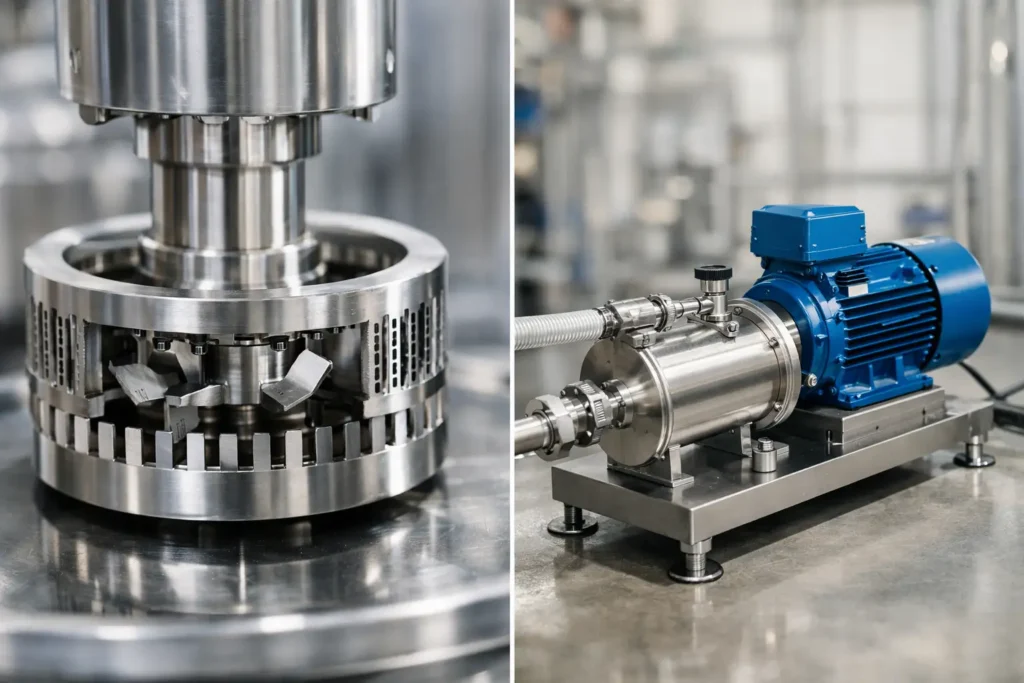
Specifying the wrong mixer rarely shows up on the quotation. It appears later as excess batch time, poor dispersion, recurring quality deviation, heat build-up, or a line that cannot scale beyond pilot performance. In a high shear vs inline mixer decision, the key question is not which technology is better in general, but which one matches the physics of your product and the realities of your plant.
For industrial manufacturers, this choice often sits at the intersection of product quality, throughput, hygiene, and integration. Food producers may need repeatable emulsification without damaging sensitive ingredients. Chemical processors may need aggressive deagglomeration with controlled residence time. Pharmaceutical and cosmetics manufacturers may need hygienic design, validated cleaning, and tight process consistency. The right answer depends on how the material moves, how much shear it needs, and where in the process that energy should be applied.
A high shear mixer is defined by the intensity of mechanical force it applies to the product. It uses a rotor-stator arrangement or similar mechanism to generate strong localised shear, reducing particle size, dispersing powders into liquids, and creating fine emulsions. In practice, high shear can be delivered in several equipment formats, including batch top-entry systems, bottom-entry units, and inline machines.
That is where some confusion starts. An inline mixer describes the installation and process arrangement rather than the shear level on its own. Inline units are installed within a recirculation loop or continuous process line, with product passing through the mixing head as it flows. Some inline mixers are high shear. Others are designed more for blending, pumping assistance, or moderate homogenisation.
So, high shear vs inline mixer is not always a strict like-for-like comparison. In many cases, the real decision is between a batch high shear mixer and an inline mixer, or between a high shear inline mixer and a lower shear inline blending device. Buyers need to separate the required mixing effect from the preferred process layout.
High shear is typically selected when the formulation demands significant energy input to achieve the target result. That usually includes powder wetting, deagglomeration, emulsification, and rapid reduction of fisheyes in difficult hydrocolloids or thickeners. If the process is sensitive to undispersed solids, visible agglomerates, or long mixing cycles, high shear is often the starting point.
This is common in sauces, creams, gels, suspensions, adhesives, sealants, slurries, and many chemical intermediates. In these applications, the mixer is not simply circulating material. It is actively changing the physical state of the dispersion.
Batch high shear systems are particularly effective where the operator needs close control over residence time, ingredient addition sequence, and vessel conditions. That matters when the product must be heated, cooled, deaerated under vacuum, or held for a defined reaction period. A vessel-based system also makes sense when viscosity rises significantly during the batch, because the process can be managed around the product’s changing rheology.
The trade-off is that high shear consumes more energy and can create more heat. For shear-sensitive ingredients, that can affect texture, particle integrity, or final product appearance. It may also increase wear in abrasive formulations. Strong shear is valuable when it solves a real process problem, but unnecessary shear can be expensive and counterproductive.
Inline mixers are often chosen for flow-through production, recirculation duties, and processes that benefit from compact integration into existing plant. They suit manufacturers looking to reduce manual intervention, improve repeatability, and support continuous or semi-continuous operation.
In an inline arrangement, material is drawn through the mixer head and processed as it travels through the system. This can be highly effective for liquid-liquid blending, moderate emulsification, powder induction, and recirculating batch improvement. It is also attractive where floor space is limited or where vessel access is restricted.
For hygienic sectors, inline systems can offer practical cleaning advantages, particularly when designed for CIP and integrated with sanitary pipework and controlled dosing. They also simplify automation in many cases, since flow rate, recirculation time, ingredient addition, and process parameters can be tied into the wider control architecture.
That said, inline mixers are not automatically the best option for every difficult product. Very high viscosities, poor product flow, or formulations that need long exposure to controlled vessel conditions may favour a different configuration. The success of an inline system depends heavily on pumpability, line design, pressure drop, residence time, and whether multiple passes are acceptable.
The biggest specification error is choosing by label rather than by duty. Two mixers described as inline can perform very differently depending on rotor speed, tip speed, stator geometry, stage configuration, clearance, and flow pattern. Likewise, two high shear mixers can differ significantly in achievable particle reduction and throughput.
If your target is powder incorporation, the critical issue is how quickly the powder is wetted and dispersed before agglomerates stabilise. If your target is emulsion quality, the focus shifts to droplet size distribution and repeatability. If your target is blending only, a lower shear technology may achieve the result with less energy and less risk of overprocessing.
This is why process data matters more than general category names. Viscosity profile, solids loading, particle characteristics, density difference between phases, batch size, flow rate, and temperature all influence the correct selection.
A useful way to approach high shear vs inline mixer selection is to start with the process objective. Are you trying to dissolve, disperse, emulsify, homogenise, suspend, or simply blend? Those are not interchangeable duties, and each places different demands on the equipment.
Next, consider product behaviour across the entire cycle. Some formulations begin as low-viscosity liquids and become thick only after hydration or reaction. Others are difficult from the first addition and need immediate, aggressive shear to avoid lumping. In many plants, the timing of shear is as important as the amount of shear.
Plant constraints also carry real weight. A continuous line may favour inline processing because it reduces handling steps and supports higher throughput. A multi-product site may prefer a vessel-based high shear arrangement because it offers greater flexibility across changing recipes. Hazardous-area classification, hygienic design standards, heating and cooling requirements, and cleaning validation all influence the final specification.
In food and beverage, batch high shear is often preferred for sauces, dressings, starch systems, and hydrocolloid dispersion where ingredient sequence and viscosity development need close management. Inline high shear units can be highly effective for recirculation, final polishing, and liquid ingredient standardisation.
In pharmaceuticals and cosmetics, the decision often turns on validation, hygienic design, and the need for fine and repeatable dispersion. Creams, gels, and lotions may benefit from high shear under vacuum in a vessel, especially when air removal is important. Inline systems are useful where continuous dosing and controlled recirculation improve consistency.
In chemicals, adhesives, and advanced materials, solids loading and rheology usually decide the outcome. Abrasive slurries, sealants, and filled compounds may demand a more specialised configuration than a standard inline mixer can provide. Where deagglomeration is central to performance, the mixing head design becomes critical.
The right equipment must work beyond the test batch. Scale-up is one of the most practical reasons to involve an engineering-led supplier early. A mixer that performs acceptably in a small trial can fail in production if tip speed, circulation pattern, or residence time do not translate at scale.
Inline systems can support clean plant layouts and good automation, but they also depend on correct pipe sizing, pump selection, valve arrangement, and instrumentation. A poorly integrated inline mixer may perform below its capability because the surrounding system limits flow or creates unstable feed conditions.
High shear vessel systems may require more structural consideration, especially with larger capacities, vacuum operation, heating and cooling jackets, or heavy product loads. Maintenance access, seal arrangement, and wear part replacement should be reviewed at the specification stage, particularly for abrasive or high-duty applications.
This is where a supplier with broad mixing capability has an advantage. PerMix UK, for example, can assess whether the process truly needs high shear, whether inline installation is appropriate, and whether a hybrid arrangement would deliver better lifecycle value.
If your process depends on aggressive dispersion, rapid deagglomeration, or fine emulsification, high shear is usually the requirement. If your process is better served by continuous flow, recirculation, compact plant integration, or automated dosing, an inline mixer may be the better route. If you need both, the answer may be an inline high shear system or a vessel-based process supported by inline recirculation.
The sensible decision comes from matching mixer design to product behaviour, not from forcing the product to fit a standard machine category. A short technical review of viscosity, solids, flow conditions, hygiene needs, and scale-up targets will usually prevent far more cost than it adds. When the mixer fits the process, production becomes easier to control, easier to repeat, and far less likely to surprise you after installation.
Stay Connected