Industrial Mixers UK
PerMix News & Updates

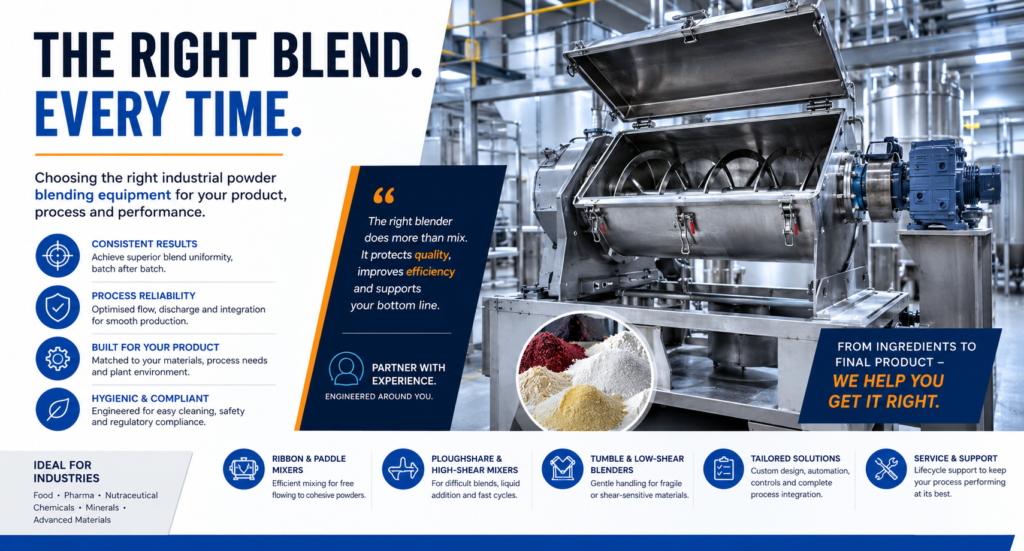
A powder blend that looks acceptable in a sample tray can still fail on the line. Segregation during discharge, inconsistent trace ingredient distribution, poor flow into downstream equipment, or extended cleaning downtime usually point to one issue – the wrong industrial powder blending equipment for the product and process.
For manufacturers handling food ingredients, pharmaceutical powders, nutraceutical formulations, speciality chemicals, minerals or advanced material compounds, blending performance is not defined by one headline figure. Batch time matters, but so do blend uniformity, discharge efficiency, hygiene requirements, containment, dust control, material sensitivity and integration with the rest of the plant. Choosing equipment on vessel size alone is rarely enough.
At plant level, powder blending is about repeatable outcomes rather than simple agitation. The equipment has to create a consistent mixture across materials that may differ in particle size, bulk density, moisture level, flow characteristics and friability. Some products blend readily. Others resist homogeneity, especially when small-volume actives or additives must be distributed through a much larger base powder.
That is why equipment selection starts with the material, not with a preferred machine style. A free-flowing dry beverage mix behaves very differently from a cohesive nutritional powder, and both differ again from a chemical premix containing fine pigments or performance additives. The mixing action, fill level, residence time and discharge method all need to suit the application.
In many cases, the blender must also do more than blend. Manufacturers may need heating or cooling jackets, vacuum capability, spray addition for liquids, lump breaking, inerting, automated recipe control or hazardous-area compliance. The most effective industrial powder blending equipment is often part of a wider engineered process solution rather than a standalone vessel.
Different blender technologies create different flow patterns. That matters because powder movement determines blend quality, cycle time and the risk of particle degradation.
Ribbon blenders are widely used where moderate to high-capacity batch blending is required for free-flowing to moderately cohesive powders. Their counter-flow action can deliver fast and efficient mixing, and they are often specified for food ingredients, chemicals and general industrial powders. They can also support limited liquid addition where the process allows.
Paddle mixers offer a somewhat gentler action in some applications and can be better suited where product integrity matters or where broader process flexibility is needed. Both designs can be configured with hygienic finishes, spray systems and tailored discharge arrangements, but neither is automatically the best choice for every powder.
For more demanding formulations, ploughshare mixers can create a mechanically fluidised mixing zone. This is useful where powders are difficult to disperse evenly, where rapid batch cycles are required, or where liquid additions need to be incorporated efficiently into a dry matrix. High-speed choppers may also be added to break agglomerates or improve dispersion.
The trade-off is that this higher-energy approach is not ideal for every material. Fragile particles may suffer attrition, and products sensitive to temperature rise or shear need careful evaluation.
Where the priority is gentle handling, tumble blending technologies can be a better fit. These systems are often selected for applications where particle shape must be preserved or where overworking the material would affect downstream performance. They can deliver excellent blend quality, but batch times may be longer and process flexibility for liquid addition is typically lower than in convective mixers.
This is a good example of why there is no universal answer in industrial powder blending equipment. The right machine depends on what the powder needs, what the process allows and what the finished product must deliver.
A common procurement mistake is to specify on volume, throughput and motor power without enough attention to material handling detail. On paper, two blenders may appear comparable. In production, the difference can be substantial.
Fill level is one example. Every mixer has an effective working capacity range, and operating outside it can reduce blend efficiency. Underfilled vessels may not generate the intended mixing pattern. Overfilled vessels can leave dead zones, increase cycle times and compromise discharge.
Discharge design is another point often underestimated. Powders that bridge or rat-hole need a discharge arrangement that promotes reliable emptying. If residual material remains in the vessel, the business is left with yield loss, extended cleaning and potential cross-contamination risk. For regulated sectors, that is not a minor nuisance. It is a process and compliance concern.
Material of construction also deserves closer review than it sometimes gets. Surface finish, weld quality, seal design and access for inspection all affect hygiene, cleanability and maintenance. In food, pharma and nutraceutical environments, those factors can be decisive.
For many UK and European manufacturers, the question is not simply whether a blender can mix effectively. It is whether it can do so in line with plant hygiene standards, operator safety requirements and site-specific regulatory obligations.
In hygienic production, cleanability must be engineered into the equipment from the start. That includes internal geometry, minimisation of crevices, appropriate surface finishes, sanitary valves and seals, and access arrangements that support inspection and validation. If wet cleaning is required, the design needs to account for drainage, drying and corrosion resistance.
In dust-sensitive or hazardous applications, containment and explosion protection may be central. Fine powders can present both occupational exposure and combustible dust risks. Depending on the product and site classification, industrial powder blending equipment may need ATEX-compliant design, earthing provisions, pressure relief, inert petrol blanketing or sealed charging and discharge systems.
These are not bolt-on considerations. They affect the whole machine layout, the choice of ancillaries and the way the system is operated. Buyers who address them early usually avoid costly redesign later.
Powder behaviour is rarely as straightforward as a data sheet suggests. Two materials with similar particle size distributions can perform very differently once loaded into a mixer, especially when trace ingredients, oils or binders are involved.
That is why practical testing is so valuable. Trial work helps determine achievable blend uniformity, typical batch time, discharge characteristics, and whether the chosen mixing principle is suitable for the product. It can also identify issues such as agglomeration, heat build-up, sticking, dust generation or ingredient segregation after blending.
For a manufacturer investing in a new line or replacing existing equipment, this stage can reduce technical risk significantly. It also supports more accurate specification of drive power, controls, loading arrangements and ancillary equipment.
The blender is only one part of the process. In practice, performance depends on how the equipment fits into the wider production system.
Upstream, that may include bulk bag discharge, sack tipping, pneumatic conveying, screening, milling or dosing systems. Downstream, the blend may feed packaging lines, tablet presses, extruders, reactors or filling equipment. If transfer methods cause segregation, even a well-blended batch can arrive at the next stage in poor condition.
Automation also has a direct impact on consistency. Recipe management, weighed ingredient charging, cycle control and data capture can improve repeatability and reduce operator dependence. For high-value or tightly regulated products, this is often as important as the mechanical blender selection itself.
This is where an engineering-led supplier adds value. A business such as PerMix UK is not simply supplying a vessel with an agitator. It is helping manufacturers define the right mixer technology, vessel geometry, control philosophy and compliance features for a specific production objective.
The most useful supplier discussions are usually the most detailed ones. Instead of starting with a model number, start with the product and process requirements. A sound review should cover powder characteristics, batch size range, target homogeneity, cycle time, cleaning method, liquid addition needs, plant layout constraints, utility availability and safety classification.
It is also worth asking what happens outside ideal conditions. How does the blender perform at minimum and maximum fill? How complete is discharge in real use? What maintenance points require routine attention? Can the design be adapted for future recipe changes? These questions tend to reveal more than a headline capacity figure.
Cost still matters, of course, but experienced buyers usually look at total operating value rather than initial purchase price alone. If a lower-cost machine increases cleaning time, product loss, changeover delays or quality variation, it can become the more expensive choice very quickly.
The right industrial powder blending equipment should support production targets without forcing compromise elsewhere in the process. That means reliable blend quality, practical cleanability, safe operation, and a design that fits both the material and the manufacturing environment. When those factors are aligned, the blender stops being a bottleneck and becomes a dependable part of the plant’s daily performance.
A worthwhile specification is not the one that looks good in a brochure. It is the one that continues to perform when recipes change, audits tighten and production schedules leave little room for error.
Stay Connected