Industrial Mixers UK
PerMix News & Updates

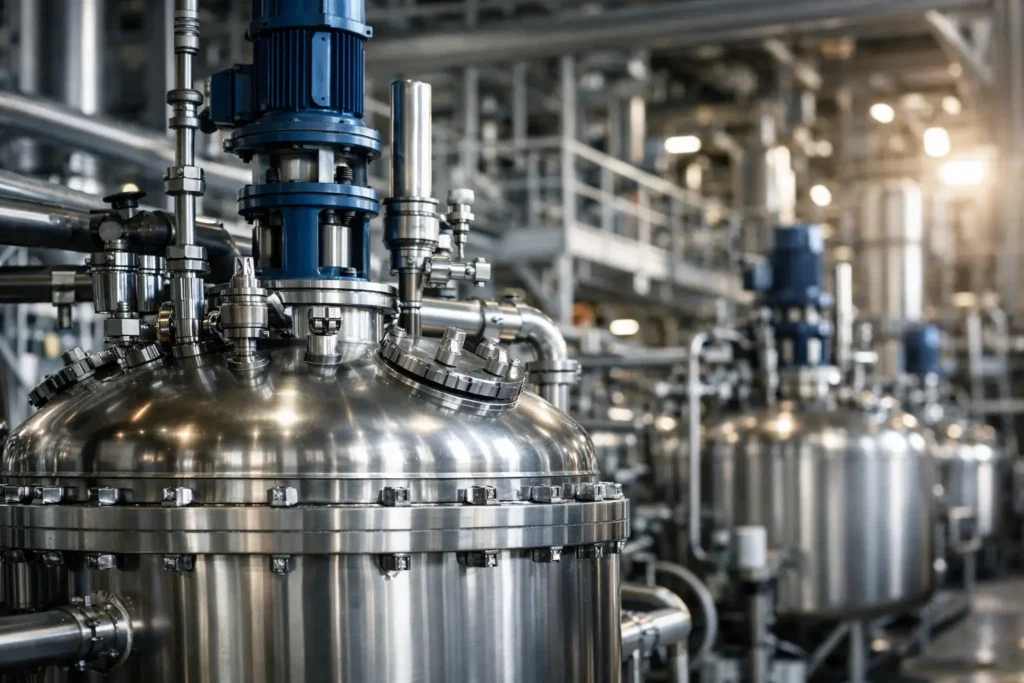
A reactor that looks acceptable on a layout drawing can still become the weak point of a production line once real product, real temperatures and real cycle times are involved. That is why industrial reactor vessel design has to start with process duty rather than vessel geometry alone. For manufacturers working with viscous products, controlled reactions, hygienic formulations or solvent-based systems, the vessel is not simply a container. It is a pressure boundary, a heat exchanger, a mixing environment and, in many cases, a compliance-critical asset.
The most successful reactor installations are designed around what the product needs to do in the vessel. That includes whether the batch must dissolve, disperse, react, crystallise, emulsify, cook, cool, ferment or deaerate. It also includes less obvious variables such as how viscosity changes during the cycle, whether solids are added gradually, whether foam develops, and how fast heat must be removed to maintain product quality.
A vessel specified mainly by volume often creates avoidable compromises. A 2,000-litre reactor for a low-viscosity chemical blend is a different engineering exercise from a 2,000-litre reactor for a high-viscosity adhesive under vacuum. The shell, jacket, agitator arrangement, seal design, instrumentation and discharge geometry may all need to change. Good design work recognises that throughput, repeatability and cleanability are shaped by these details.
The vessel body is usually the first visible decision, but it should not be treated as the only important one. Material of construction must match both the product and the cleaning regime. In many food, pharmaceutical and cosmetics applications, stainless steel grades are selected for corrosion resistance, hygiene and ease of maintenance. In chemical duties, compatibility with solvents, acids, alkalis or abrasive solids can drive different material and finish requirements.
Wall thickness and mechanical design are governed by pressure, vacuum, temperature and applicable design codes. Even where a process is nominally atmospheric, cleaning cycles, product vapours or emergency scenarios can introduce loads that need to be considered early. Head design, nozzle reinforcement and support arrangement also matter because they affect not only structural integrity but maintenance access and installation footprint.
Geometry has a direct impact on process behaviour. Height-to-diameter ratio influences mixing efficiency, heat transfer area and batch turnover. A dished base may be suitable for some duties, while a conical or dished-bottom discharge arrangement may be preferable where complete emptying is important. Dead zones around outlet valves, side entries or internal fittings can become product retention points, which is a significant concern in hygienic and high-value formulations.
In most applications, reactor performance depends on how well the vessel works with the mixing system. Agitator type should be chosen according to viscosity, shear sensitivity, solids loading and the need for axial or radial flow. Anchor agitators, paddles, turbines, high-speed dispersers and multi-shaft combinations each solve different process problems. There is no single best agitator for every reactor vessel.
This is where industrial reactor vessel design often succeeds or fails. If the agitator is underspecified, heat transfer at the wall can be poor, solids can settle, and the batch may develop localised temperature differences. If it is oversized or poorly matched, shear-sensitive products can be damaged, air can be entrained and power consumption can rise without a process benefit.
Heating and cooling design deserves the same level of scrutiny. Jackets, half-pipe coils or internal coils may be used depending on pressure, thermal duty and cleaning requirements. A simple jacket can be effective for many duties, but demanding exothermic reactions or viscous products may require more aggressive heat transfer arrangements. The trade-off is that more complex thermal systems can increase fabrication cost and maintenance complexity.
Temperature control is not just about reaching setpoint. It is about how evenly the batch reaches setpoint, how quickly the system responds to reaction heat, and whether product quality remains consistent from the first batch to the thousandth. That is particularly relevant in sectors where texture, particle size, moisture content or reaction completeness are tightly specified.
Many reactors are expected to do more than hold product under ambient conditions. Vacuum capability may be required for deaeration, solvent recovery, moisture removal or lower-temperature processing. Pressure rating may be required for reaction control, gas blanketing or specific chemical pathways. These operating modes affect shell design, seal selection, valve arrangement and instrumentation.
Hazardous-area classification can introduce another layer of design work. If flammable solvents, vapours or dusts are present, the vessel system may need appropriately rated motors, instruments and control components. Earthing, venting and overpressure protection also become more critical. In these cases, compliance is not a paperwork exercise tagged on at the end. It must be built into the equipment concept from the beginning.
For buyers comparing suppliers, this is a useful dividing line. A reactor supplier should be able to discuss not just vessel dimensions, but the relationship between process risk, applicable standards and practical operating safeguards.
In food, beverage, pharmaceutical and personal care production, the vessel has to support hygiene as well as output. Internal finish, weld quality, crevice minimisation and drainability all influence how effectively the system can be cleaned. Poorly designed internals can trap product behind baffles, around probes or beneath agitator assemblies, leading to longer cleaning times and greater cross-contamination risk.
Clean-in-place design is often expected, but it only works properly when spray device coverage, internal geometry and drain paths are coordinated. A spray ball added to a poorly arranged vessel does not create a hygienic system. The same applies to shaft seals, manways and top-mounted instrumentation, which need to be specified with routine cleaning and inspection in mind.
The right finish level depends on the application. Some sectors can operate effectively with standard industrial finishes, while others require polished internals and tighter documentation around materials, weld procedures and surface condition. Over-specifying hygiene features can increase project cost unnecessarily, but under-specifying them can create expensive operational problems later.
A modern reactor vessel is rarely an isolated piece of stainless steel. It is usually part of a controlled process where temperature, pressure, vacuum, agitation speed, load cells and dosing sequences need to work together. Instrumentation strategy should therefore be tied to how the batch is run, not added afterwards as a controls package.
Sensor placement matters. A temperature probe in the wrong position may read jacket influence rather than true product temperature. Level measurement that performs well in a clean liquid may struggle in a foaming or viscous batch. Sampling points should be accessible and representative, particularly where reaction progress or product conformity must be verified during the cycle.
Automation level depends on production priorities. Some plants need straightforward local control with operator intervention. Others need full recipe management, batch traceability, interlocks and integration with upstream and downstream equipment. Neither approach is automatically right. The correct choice depends on compliance needs, operator skill, production volume and the cost of inconsistency.
Standard reactor vessels can be an efficient route where the process is well understood and the duty is relatively conventional. They can reduce lead times and provide a sensible cost base. However, once the process involves unusual viscosity ranges, multiple thermal stages, vacuum operation, hazardous-area constraints or strict plant space limits, bespoke design often becomes the practical option.
That does not always mean starting from a blank sheet. In many cases, the best outcome comes from adapting a proven vessel platform with application-specific agitators, jackets, internals and control architecture. An engineering-led supplier such as PerMix UK can add value here by matching standard manufacturing capability with process-specific configuration, rather than forcing the application to fit a generic tank.
The key is to be clear about what really needs customisation. Buyers sometimes focus on nominal vessel size and overlook discharge arrangement, seal design, maintenance access or utility connections, even though those details often determine day-to-day usability.
A good specification review goes beyond asking for volume, pressure rating and motor size. It should test whether the proposed design reflects actual process conditions across the full batch cycle. That means discussing minimum and maximum working volumes, viscosity changes, cleaning chemicals, utility temperatures, residence time expectations and any known history of fouling, scorching or air entrapment.
It is also worth challenging how the vessel will behave in off-design conditions. What happens if cooling water supply varies, a raw material is charged late, or the batch reaches a higher-than-expected viscosity? A reactor that performs well only under ideal conditions may create avoidable downtime in production.
The strongest projects usually come from early collaboration between the equipment supplier, process team and operations stakeholders. That allows practical issues such as platform access, maintenance clearance, lifting constraints and future expansion to be addressed before fabrication begins.
Industrial reactor vessel design is at its best when it turns process demands into stable, repeatable plant performance. The right vessel should give you control, not just capacity – and that is the standard worth holding from the first specification review onwards.
Stay Connected