Industrial Mixers UK
Pin Mills

 Pin Mills
Best in Innovation • Best In Performance • Best In Quality • Best In Price • Best In Warranty
Unveiling the Power of Pin Mills: Your Ultimate Guide to Precision Grinding
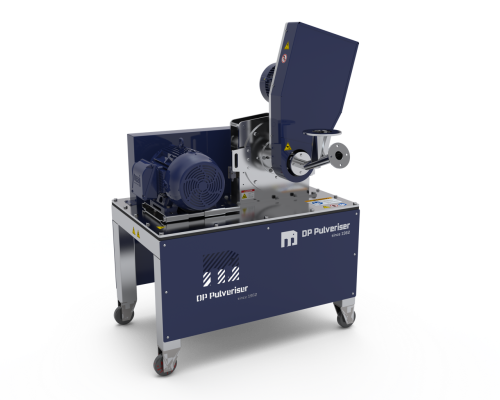
Pin mills & Cryogenic Pin Mills are high-speed impact mills designed for fine grinding, de-agglomeration, and uniform particle size reduction across a wide range of dry materials. They offer an excellent balance between precision, throughput, and operating simplicity—making them one of the most widely adopted milling technologies across the UK and Europe.
On the PerMix UK website, our pin mills—manufactured
by DP Pulverizers—are engineered for industrial reliability, consistent results, and seamless integration into modern processing lines.
A pin mill reduces particle size using intermeshing rows of pins mounted on one or two rotating discs. As material passes through the milling chamber, it is subjected to intense impact and shear forces, fracturing particles rapidly and efficiently.
Unlike jet mills, pin mills rely on mechanical energy rather than compressed gas, making them simpler to operate while still capable of achieving fine particle sizes—typically in the low micron range.
They are particularly effective for:
Brittle and semi-brittle materials
De-agglomeration of powders
Applications requiring tight but not sub-micron control
Material is fed into the centre of the mill and accelerated outward by a high-speed rotor. As particles encounter stationary or counter-rotating pins, repeated impacts reduce particle size until the material exits the grinding zone.
Key characteristics of the process:
High tip speeds for efficient size reduction
Short residence time
Predictable and repeatable grinding behaviour
Minimal over-grinding when correctly configured
Optional internal classification or external screening can further refine the final particle size distribution.
Pin mills from DP Pulverizers are designed for industrial-scale performance, not laboratory novelty.
They offer:
Fine grinding down to low-micron ranges
High throughput compared to jet milling
Compact footprint and straightforward installation
Lower operating cost than compressed-gas systems
Excellent repeatability for production environments
Available configurations include:
Single-rotor or counter-rotating designs
Wear-resistant construction for abrasive products
Sanitary and pharmaceutical-grade finishes
Temperature control options for heat-sensitive materials
For many UK & EU manufacturers, pin mills represent the sweet spot between precision and practicality.
Pin mills are widely used across industries where consistent fine grinding and de-agglomeration are required:
Pharmaceuticals & nutraceuticals – excipients, actives, herbal blends
Food & ingredients – sugars, starches, spices, additives
Chemicals – pigments, resins, powders, intermediates
Minerals & industrial materials – fillers, functional powders
Recycling & sustainability applications – controlled size reduction of dry solids
They are particularly well suited to applications where jet milling would be excessive and hammer milling insufficient.
Pin mills occupy a valuable middle ground:
Finer and more controlled than hammer mills
Higher throughput and simpler operation than jet mills
More uniform output than many universal mills
When product temperatures, energy consumption, and operating cost all matter, pin mills often emerge as the most efficient solution.
Pin mills rarely operate alone. PerMix UK frequently integrates pin mills with:
Pre-breakers or coarse mills
Feeding and dosing systems
Air classification or screening
Powder mixing and blending equipment
Dust-controlled discharge and containment
This ensures consistent product quality while supporting modern UK & EU safety and compliance expectations.
Selecting a pin mill is not just a purchasing decision—it’s a process decision.
PerMix UK supports customers with:
Application-specific mill selection
Pilot testing and scale-up guidance
CE, UKCA, and ATEX-aligned designs
Turn-key milling, mixing, and material handling systems
Long-term technical support
The result is a pin milling solution that works day one—and keeps working years later.
Selecting the right pin mill is about matching material behaviour with mechanical energy, not chasing headline RPM numbers. Pin mills reward thoughtful configuration and punish guesswork—so a clear selection process matters.
Here’s how UK & EU manufacturers typically get it right.
Pin mills perform best on materials that fracture cleanly under impact.
Key questions:
Is the material brittle, crystalline, or friable?
Does it tend to smear, melt, or gum up?
Is de-agglomeration as important as size reduction?
Pin mills excel with dry, brittle, and semi-brittle materials. Sticky or highly elastic products may require cooling, conditioning, or an alternative milling approach.
Pin mills typically produce powders in the fine to low-micron range, but they are not designed for true sub-micron control.
Clarify:
Target d50 and top-cut size
Acceptable particle size spread
Sensitivity to fines generation
If ultra-tight PSD or sub-micron output is required, jet milling may be more appropriate. If consistency, throughput, and simplicity are the priority, pin mills are often the better choice.
Pin mill configuration directly impacts grinding intensity.
Single-rotor designs:
Lower energy input
Reduced heat generation
Excellent for gentle grinding and de-agglomeration
Counter-rotating designs:
Higher impact energy
Finer achievable particle sizes
Higher throughput for demanding applications
The correct choice depends on how aggressively the material must be fractured to reach the desired size.
Pin mills generate more heat than jet mills—but far less than many expect when properly configured.
For heat-sensitive materials, consider:
Optimised pin geometry
Reduced residence time
Cooling jackets or conditioned air
Cryogenic or chilled operation (where applicable)
This makes pin mills viable for many food, nutraceutical, pharmaceutical, and chemical products that would otherwise be at risk.
Pin mills are often selected because they scale efficiently.
Ask:
Is this a pilot or full-production system?
Will formulations or SKUs change frequently?
Is cleaning and changeover time critical?
Pin mills scale cleanly from R&D to production without changing fundamental milling principles—an advantage for UK manufacturers planning growth.
Material abrasiveness and hygiene requirements matter.
Options include:
Hardened or wear-resistant pins and liners
Sanitary construction for food and pharma
Tool-less access for inspection and cleaning
Pin mills from DP Pulverizers are designed with serviceability in mind, reducing downtime and lifecycle cost.
UK & EU pin mill selection must align with:
CE and UKCA requirements
ATEX zoning (where applicable)
Dust containment and explosion mitigation
GMP or hygienic design standards
Compliance should be built in—not bolted on later.
This comparison is one of the highest-intent decision points for buyers—and one of the most misunderstood.
Hammer mills rely on swinging hammers that shatter material against screens.
Pin mills use controlled, high-speed impact between fixed pins, producing a more uniform and predictable grind.
Hammer mills:
Broad PSD
Higher fines generation
Screen-dependent output
Pin mills:
Tighter PSD
Better control at finer sizes
Less reliance on screens
When consistency matters, pin mills win.
Hammer mills:
Longer residence time
Higher friction
Greater risk for heat-sensitive materials
Pin mills:
Shorter residence time
More efficient energy transfer
Lower thermal stress when configured correctly
Hammer mills are well suited for:
Coarse grinding
High-fibre materials
Applications tolerant of variability
Pin mills are preferred for:
Fine grinding
De-agglomeration
Ingredients, chemicals, and actives where uniformity matters
Pin mills generally offer:
Lower compressed energy demand than jet mills
More predictable maintenance than hammer mills
Cleaner integration into closed-loop systems
They often represent the best balance of performance, cost, and control for modern UK & EU operations.
Choose a hammer mill when size reduction is rough and forgiving.
Choose a pin mill when particle size begins to influence performance, quality, or compliance.
Pin mills are widely used across the UK and Europe when manufacturers need reliable fine grinding, de-agglomeration, and consistent particle size control without the complexity or operating cost of compressed-gas systems.
Pin mills supplied through PerMix UK and manufactured by DP Pulverizers are engineered for continuous production, clean integration, and repeatable performance across a wide range of industries.
In regulated environments, pin mills are commonly used where uniformity and repeatability are essential but sub-micron precision is not required.
Typical applications include:
Excipients and pharmaceutical intermediates
Herbal powders and nutraceutical blends
Vitamin and mineral premixes
De-agglomeration of spray-dried ingredients
Pin mills offer controlled energy input, predictable PSD, and straightforward validation—making them a practical choice for GMP-driven operations.
Pin mills are a staple in food processing where product integrity and flavour retention matter.
Common UK & EU food applications:
Sugars and sugar derivatives
Starches and flours
Spices, seasonings, and dry blends
Functional food ingredients
Short residence time and efficient impact reduce thermal stress, helping preserve flavour, colour, and functional properties.
For chemical manufacturers, pin mills provide repeatable fine grinding with tighter control than hammer mills.
They are used for:
Pigments and dyes
Resins and polymer powders
Chemical intermediates
Functional additives and fillers
Consistent particle size improves dispersion, reaction efficiency, and downstream handling.
Pin mills are frequently selected for processing brittle mineral materials where controlled fineness is required.
Typical materials include:
Calcium carbonate and similar fillers
Talc and silica-based powders
Industrial salts
Performance minerals for coatings and plastics
Pin mills deliver finer, more uniform results than hammer mills while remaining cost-effective at scale.
As UK and EU manufacturers push toward sustainable processing, pin mills are increasingly used in recycling and reprocessing applications.
Examples include:
Controlled grinding of recovered powders
De-agglomeration of recycled materials
Preparation of secondary raw materials
Size reduction for reintroduction into manufacturing streams
Their mechanical simplicity makes pin mills well suited for continuous, industrial duty in circular processes.
Pin mills are widely used in:
Pilot plants
R&D facilities
Multi-SKU production environments
They allow:
Fast changeovers
Scalable process development
Reliable transition from lab to production
This makes them particularly attractive for UK manufacturers balancing innovation with production efficiency.
Across industries, pin mills are selected when:
Fine grinding or de-agglomeration is required
Tight but not sub-micron PSD is acceptable
Throughput and consistency matter
Operating simplicity and cost control are priorities
They often represent the most practical solution between hammer mills and jet mills.
Pin mills deliver their best performance when integrated correctly. PerMix UK regularly supplies pin mills as part of:
Turn-key milling systems
Feeding and dosing lines
Air classification and screening stages
Mixing and blending systems
Dust-controlled handling solutions
This systems-first approach ensures reliable operation, regulatory alignment, and long-term process stability.
Cryogenic pin mills are specialised grinding systems designed to process materials that cannot be milled effectively at ambient temperatures. By cooling the product—typically with liquid nitrogen—materials become brittle, allowing clean, efficient size reduction without smearing, melting, or thermal degradation.
PerMix UK supplies cryogenic pin milling systems manufactured by DP Pulverizers, engineered for UK and EU manufacturers working with heat-sensitive, elastic, oily, or volatile materials.
A cryogenic pin mill combines a high-speed pin milling chamber with controlled cryogenic cooling, usually achieved by injecting liquid nitrogen upstream of the mill.
Cooling the material:
Lowers its temperature well below ambient
Increases brittleness
Reduces elasticity and stickiness
Prevents heat buildup during grinding
Once embrittled, materials that are normally impossible to grind cleanly can be reduced to fine, consistent powders using standard pin mill mechanics.
At room temperature, many materials resist size reduction. They smear, deform, melt, or coat the pins.
At cryogenic temperatures, the physics changes.
Benefits include:
Clean fracture instead of deformation
Dramatically reduced heat generation
Improved particle size consistency
Reduced agglomeration
Preserved flavour, aroma, and functionality
In short: the mill stops fighting the material.
Material is pre-cooled using liquid nitrogen before entering the pin mill. As the temperature drops below the material’s glass transition or embrittlement point, it becomes friable.
Inside the mill:
High-speed pins apply controlled impact
Brittle particles fracture efficiently
Short residence time prevents rewarming
Powder exits cleanly without smearing
The process is continuous, controllable, and scalable—from pilot systems to full production lines.
Cryogenic pin milling is widely used across UK & EU industries for materials that are otherwise difficult or impossible to grind:
Spices and seasonings
Flavours and aroma compounds
Gums and resins
High-oil or high-fat ingredients
Cryogenic processing preserves volatile compounds and prevents flavour loss.
Heat-sensitive APIs
Herbal extracts
Soft or elastic actives
Thermally unstable intermediates
Cryogenic pin mills help maintain potency and stability while achieving fine particle sizes.
Rubber compounds
Thermoplastics
Elastomeric materials
Specialty polymers
Cooling converts elastic materials into brittle solids, enabling efficient size reduction.
Resins and waxes
Adhesives
Low-melting-point compounds
Sticky or hygroscopic materials
Cryogenic grinding prevents coating and build-up inside the mill.
Compared to conventional pin milling, cryogenic systems offer:
Lower product temperatures
Cleaner milling with less fouling
Finer achievable particle sizes
Improved yield and consistency
Reduced downtime for cleaning
For challenging materials, cryogenic pin mills are not an upgrade—they’re the only viable solution.
Cryogenic pin mills are typically supplied as complete systems, including:
Liquid nitrogen dosing and control
Insulated feed and transfer points
Temperature monitoring
Enclosed, dust-controlled operation
Integration with feeding, conveying, and mixing systems
PerMix UK engineers these systems to meet CE, UKCA, and ATEX expectations, ensuring safe and compliant operation.
Cryogenic pin milling makes sense when:
The product smears, melts, or gums at ambient temperature
Heat degrades flavour, potency, or performance
Elastic or oily materials resist conventional grinding
Consistency and yield are critical
It’s a precision solution for materials that refuse to behave.
Cryogenic pin mills are often integrated with:
Pre-cooling and conditioning stages
Air classification or screening
Powder mixing and blending
Dust-controlled material handling
This allows UK manufacturers to design stable, repeatable processes for even the most stubborn materials.
Our range of pin mills to revolutionize your grinding experience. Contact us today to discover how this innovative technology can transform your production efficiency!
PerMix is here to listen to your needs and provide sustainable solutions. Contact us to discover more.