Industrial Mixers UK
PerMix News & Updates

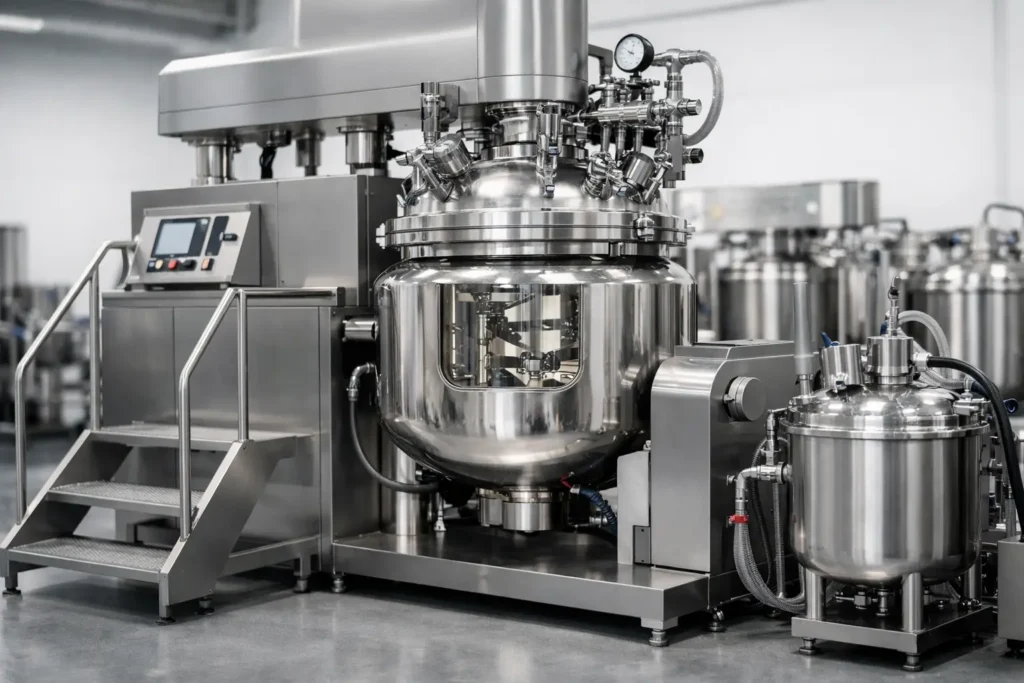
A batch that looks right in the vessel can still fail in filling, storage or end use. Air entrapment, unstable droplet size, poor powder wet-out and inconsistent heat transfer are common causes. A vacuum emulsifying mixer machine is designed to address those process weaknesses directly, combining high-shear mixing with vacuum deaeration and, where required, controlled heating and cooling in a single system.
For manufacturers working with creams, gels, ointments, sauces, emulsions, slurries and other high-value formulations, the machine is not simply a mixer with a lid. It is a process platform. The real value lies in how well it controls the interaction between shear, temperature, pressure and product flow, because that is what determines repeatability at production scale.
At its core, a vacuum emulsifying mixer machine is built to create stable, uniform mixtures where one phase must be dispersed finely into another. In practical terms, that often means oil into water, powders into liquids, or active ingredients into a viscous base. The vacuum function removes entrained air and helps draw in materials cleanly. The emulsifying function applies intense mechanical shear to reduce particle or droplet size and distribute components evenly.
This matters because many products are sensitive to trapped air, poor dispersion and uncontrolled viscosity build-up. In cosmetics, air can affect appearance, fill accuracy and texture. In pharmaceuticals and nutraceuticals, it can interfere with dose uniformity and downstream packing. In food applications, it can shorten shelf life, alter mouthfeel or destabilise the emulsion. In chemicals, it may compromise performance, cure profile or coating quality.
Most industrial systems combine several actions within one vessel. An anchor or scraper agitator moves bulk product and improves wall heat transfer. A rotor-stator homogeniser generates the shear needed for emulsification and fine dispersion. Vacuum reduces foaming and oxidation while supporting deaeration. Jacketed construction enables heating or cooling as the process requires.
Without vacuum, many formulations trap air as soon as agitation begins. That air can come from powder addition, recirculation, high-speed shear or the product’s own rheology. Once entrained, it is often difficult to remove, especially in viscous batches.
A vacuum environment changes several things at once. It limits oxidation, reduces foam formation and improves deaeration during mixing. It can also support powder induction when systems are configured for controlled ingredient addition. The result is often a smoother product with better visual quality, more consistent density and fewer defects during filling.
That said, vacuum is not automatically the right choice for every batch. Some processes benefit more from atmospheric pre-mixing followed by vacuum finishing. Others need staged vacuum levels to avoid excessive flashing of volatile components or moisture loss. The right configuration depends on formulation behaviour, batch size and thermal sensitivity.
A well-specified machine should be judged by more than nominal vessel volume or motor size. Process performance depends on how the main components work together under real production conditions.
The anchor agitator handles macro-mixing and keeps the batch moving through the vessel. Scrapers are often used where heating or cooling is important, particularly with viscous products that would otherwise insulate the vessel wall. The high-shear emulsifying head then performs the fine work, reducing particle size and creating uniform structure.
The relationship between these two mixing actions matters. Too much shear without sufficient bulk movement can create localised overheating or inconsistent circulation. Too little shear leaves coarse dispersion and poor emulsion stability. Good machine design balances tip speed, residence time and flow pattern rather than relying on motor power alone.
The vacuum package must be sized appropriately for vessel volume, product vapour behaviour and desired cycle time. It should also be integrated with seals, sight glasses, valves and manways that maintain vacuum integrity during operation. If the machine is expected to run repeatedly with demanding products, mechanical durability is not optional.
Vessel construction is equally important. Surface finish, weld quality and hygienic detailing affect cleanability and compliance. For regulated sectors, these details can influence validation effort as much as production performance.
Many emulsification processes are temperature-dependent. Waxes must melt, powders hydrate within a defined range, and viscosity often shifts sharply during heating or cooling. Jacketed vessels, insulated surfaces and precise temperature control therefore play a major role in batch consistency.
In some applications, direct heating is less suitable than indirect thermal transfer through a jacket. In others, rapid cooling is essential to lock in product structure. A machine that mixes well but controls heat poorly may still produce inconsistent results.
The strongest case for a vacuum emulsifying mixer machine is usually found in processes where both product quality and consistency are commercially critical.
In cosmetics and personal care, these machines are widely used for creams, lotions, gels, serums, balms and hair care formulations. Texture, gloss, stability and deaeration are all visible to the end user, so process control has direct product value.
In pharmaceuticals and nutraceuticals, they are used for ointments, topical gels, medicated creams and suspension-type products where ingredient distribution and hygienic manufacture are central requirements. In these sectors, documentation, cleanability and repeatability are often as important as mixing performance.
Food manufacturers use similar systems for mayonnaise, dressings, spreads, dessert bases, flavour emulsions and speciality sauces. Here, the process must often manage shear-sensitive ingredients, thermal treatment and air control without damaging product structure.
Speciality chemicals, adhesives and sealants also benefit where fine dispersion, controlled viscosity and low entrained air are required. However, these applications may demand more attention to materials of construction, seal compatibility, explosion protection or aggressive cleaning regimes.
The best buying decisions usually start with the product, not the machine catalogue. A technically suitable specification should reflect formulation behaviour, production target and plant constraints.
Begin with viscosity range across the full cycle, not just the final product. Many batches start low-viscosity and become far thicker as powders hydrate or phases combine. That affects agitator design, homogeniser sizing and discharge strategy.
Then look at batch size and turndown. A machine that performs well at maximum fill may struggle on smaller development or campaign batches if the mixing head is poorly positioned. Equally, nominal vessel volume is not the same as working capacity.
Ingredient addition is another frequent source of process inefficiency. Powders that float, lump or agglomerate may require vacuum-assisted induction, side-entry feeding or dedicated powder incorporation systems. Liquids with different densities may need staged addition and controlled circulation. If the machine is expected to support recipe flexibility, these details should be considered early.
Control philosophy also deserves attention. For some sites, basic speed and temperature control is enough. For others, recipe management, data logging, load cells, automated valve sequences and integration with upstream or downstream equipment are necessary. A more sophisticated control system costs more initially, but it can reduce operator dependency and improve batch traceability.
There is no single right answer. Standard vacuum emulsifying systems are often the most efficient route where the product family is well understood and the required process envelope is conventional. They can offer shorter lead times, lower capital cost and proven mechanical arrangements.
Bespoke design becomes more relevant when the process includes unusual viscosities, abrasive ingredients, hazardous-area requirements, strict hygienic protocols or difficult site limitations. It is also the better route when mixing must be integrated with melting vessels, transfer systems, inline homogenisers or automated CIP arrangements.
For many manufacturers, the practical choice sits somewhere in between – a standard platform with application-specific modifications. That may include alternative seal arrangements, upgraded finishes, additional heating capacity, custom discharge geometry or tailored instrumentation. An engineering-led supplier such as PerMix UK can add value here by matching the machine build to the actual process rather than forcing the process to fit a fixed machine design.
One of the most frequent mistakes is comparing machines on headline power alone. Higher motor ratings do not guarantee better emulsification or shorter batch times if the shear head, vessel geometry and flow pattern are not matched to the formulation.
Another is underestimating cleaning and changeover needs. In multi-product environments, dead spots, difficult access and poor drain-down can become expensive very quickly. The machine should support the plant’s real operating rhythm, not just the ideal process on paper.
It is also worth checking how performance claims were established. A supplier that can discuss product rheology, heat transfer, scale-up and compliance in detail is usually giving a more reliable basis for specification than one focused only on brochure features.
The right vacuum emulsifying mixer machine should improve more than just mixing. It should support product quality, process stability and commercial confidence at the same time. When the specification reflects the real behaviour of the product and the demands of the plant, the equipment becomes a dependable production asset rather than a compromise that operators learn to work around.
Stay Connected