Industrial Mixers UK
PerMix News & Updates

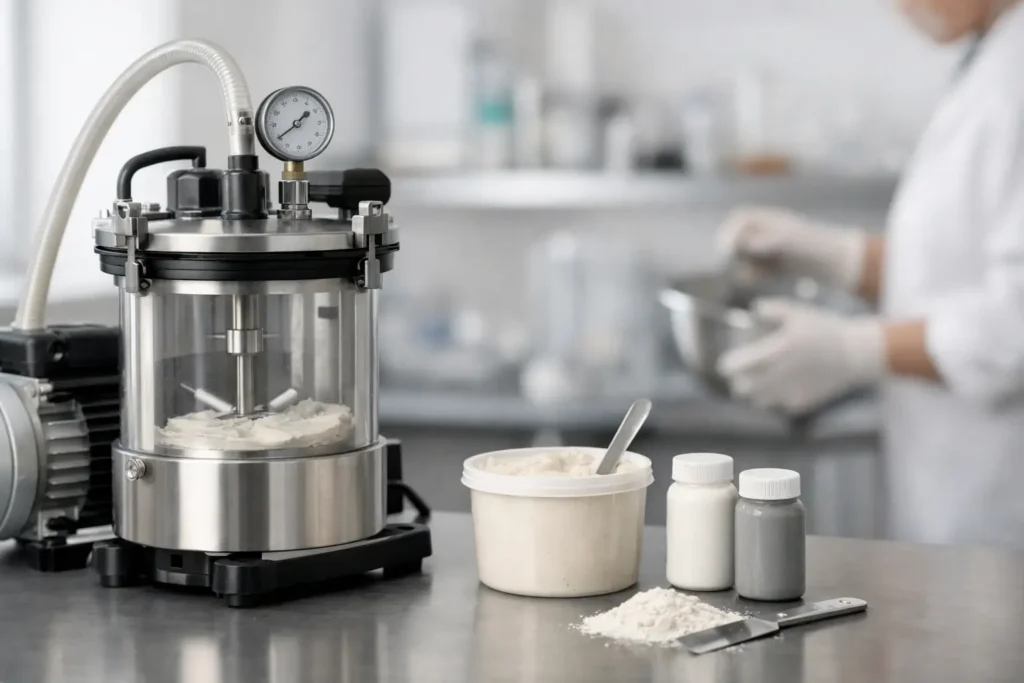
Air in a batch rarely announces itself politely. It shows up later as pinholes in a coating, foam in a cosmetic cream, voids in an adhesive, poor density in a compound, or inconsistent fill weights on the line. That is usually the point at which teams start asking when is vacuum mixing needed, and whether standard atmospheric mixing is still enough for the product and process.
The short answer is that vacuum mixing is needed when entrained air, volatile behaviour, product sensitivity, or process quality targets cannot be controlled effectively under normal pressure. But the practical answer is more specific than that. Vacuum is not a default feature to add for its own sake. It is a process tool used where deaeration, product integrity, and repeatable performance justify the added equipment complexity.
Vacuum mixing becomes relevant when the mixing action itself pulls air into the product, or when the material naturally traps air because of its viscosity, surface tension, or formulation structure. This is common in high-viscosity pastes, creams, gels, sealants, resins, slurries, and filled compounds. It can also matter in lower-viscosity systems that foam easily or where dissolved gases affect the finished result.
In industrial terms, the need usually appears in one of four situations. The first is product quality, where visible bubbles, internal voids, or inconsistent texture are unacceptable. The second is functional performance, where trapped air changes density, thermal behaviour, bond strength, electrical properties, or shelf stability. The third is downstream processability, where filling, pumping, coating, casting, or packaging become unstable because of aeration. The fourth is compliance or hygiene, especially in regulated sectors where batch consistency and controlled processing conditions matter.
That is why vacuum mixing is widely specified in pharmaceuticals, cosmetics, food, speciality chemicals, adhesives, sealants, and advanced material applications. In each case, the issue is not simply mixing ingredients together. It is mixing them while controlling gas content.
A practical way to assess whether vacuum mixing is necessary is to look at what the batch does during and after mixing. If the product foams heavily, rises in the vessel, or retains visible bubbles after mixing, vacuum should be considered. The same applies if the finished product shows inconsistent density, surface defects, or a texture that varies from batch to batch despite stable formulation inputs.
Another indicator is extended batch time. Some manufacturers compensate for entrained air by slowing agitator speed, holding the batch for long settling periods, or adding a separate deaeration step. If production depends on waiting for bubbles to escape naturally, the mixer may be doing only half the job. Vacuum can shorten that recovery period and improve throughput.
There is also a materials-handling sign. Products with powders added into liquids often entrain air at the wet-out stage, particularly where fine powders, thickeners, or light bulk density ingredients are involved. If the process creates stubborn foam or fish-eyes while incorporating powders, vacuum can support both dispersion and deaeration when paired with the right mixer geometry.
The strongest case for vacuum mixing is often found in viscous materials. Once air is incorporated into a heavy paste or cream, it does not escape easily. The product resists bubble rise, and standard agitation may simply keep redistributing the trapped air rather than removing it.
This is why vacuum-capable mixers are common in applications such as ointments, cosmetic creams, silicone compounds, adhesives, sealants, putties, solder pastes, battery slurries, and filled polymer systems. In these products, even a small amount of entrained air can create disproportionate problems. A cosmetic cream may lose the required smoothness and appearance. A sealant may cure with voids. A slurry may show variable density or poor coating behaviour. An adhesive may underperform in bond strength or application finish.
Under vacuum, gas expansion and pressure reduction help bubbles break free from the matrix. The result is typically a denser, more uniform product. That does not mean vacuum alone solves everything. Impeller design, shear level, vessel geometry, temperature control, and ingredient addition sequence still matter. Vacuum is highly effective, but only when the overall process is engineered properly.
Some products need vacuum not only for deaeration, but for protection. Oxygen exposure can degrade certain actives, alter colour, affect flavour, or reduce shelf life. Moisture-sensitive and oxidation-sensitive formulations may benefit from closed, controlled mixing conditions, particularly when combined with inert gas management or precise temperature control.
In reaction-based processes, reduced pressure may also support solvent removal, moisture reduction, or controlled evaporation. This is not the same as basic deaeration, but it sits within the same equipment decision. If a process requires mixing while removing volatiles or managing pressure-sensitive behaviour, vacuum capability can move from optional to necessary.
There are trade-offs. Not every reactive or sensitive product should be mixed under deep vacuum from start to finish. Some formulations need atmospheric conditions during one phase and vacuum during another. Others need staged pressure control to avoid excessive foaming or loss of desirable volatiles. This is where application-specific design becomes essential.
In food production, vacuum mixing is often used where texture, appearance, and filling accuracy matter. Sauces, emulsions, fillings, confectionery masses, and viscous prepared foods can all benefit from reduced air content. Air can affect not just appearance but also oxidation, pack weight consistency, and thermal processing behaviour.
In pharmaceuticals and nutraceuticals, vacuum is frequently used for creams, gels, ointments, and suspensions where homogeneity and presentation are tightly controlled. In these sectors, hygienic design, cleanability, and batch repeatability are usually as important as the mixing action itself.
In cosmetics, vacuum is commonly specified because premium finish is part of the product requirement. A cream or gel that contains microbubbles may still be chemically correct, but commercially it can fail visual and sensory expectations.
In chemicals, adhesives, and sealants, the argument is often performance-led. Entrained air can compromise cured structure, dispensing behaviour, and end-use function. Advanced materials add another layer, as air can interfere with conductivity, coating uniformity, or density targets.
Not every batch benefits from vacuum. If the product is low viscosity, non-foaming, and tolerant of minimal entrained air, atmospheric mixing may be entirely adequate. The same applies where downstream degassing already exists and does not create a bottleneck. Adding vacuum unnecessarily can increase capital cost, maintenance requirements, sealing complexity, and cleaning considerations.
There are also products that can foam more aggressively when pressure is reduced too quickly. In those cases, vacuum without proper control may create new problems rather than solve existing ones. Some processes are better served by improved agitator selection, slower powder induction, baffle changes, or temperature adjustment before moving to a vacuum system.
The right question is not whether vacuum sounds advanced. It is whether the product and process economics support it. If vacuum improves yield, reduces rejects, shortens cycle time, or stabilises quality, it can be commercially justified very quickly. If it offers little measurable process benefit, it may be an unnecessary specification.
A sound specification decision starts with the product behaviour, not the equipment brochure. Look at whether air is being introduced, whether it is being retained, and what effect it has on quality or throughput. Then review the operating conditions – viscosity range, shear requirement, temperature profile, powder addition method, batch volume, and any need for heating, cooling, or pressure-rated operation.
From there, consider the process target. Are you trying to eliminate visible bubbles, achieve a tighter density window, improve dispersion, protect a sensitive formulation, or remove volatiles during mixing? Different goals may point to different mixer types and vacuum levels.
This is also why vacuum mixing decisions should not be separated from vessel and system design. Seal arrangement, condensate handling, lid configuration, scraper design, instrumentation, and cleanability all influence whether the system performs reliably in production. For many industrial users, a bespoke or semi-custom configuration is the difference between a vacuum mixer that works on paper and one that works shift after shift.
A useful rule is this: if entrained air affects product acceptance, processing efficiency, or end-use performance, vacuum mixing deserves serious evaluation. If air is incidental and easily managed by simpler means, it probably does not.
The best vacuum mixing systems are not specified because vacuum sounds impressive. They are specified because the process has made the requirement clear, and the engineering has been matched to it properly.
Stay Connected